Home › The journal › How to choose artisanal charcuterie
How to choose artisanal charcuterie in France
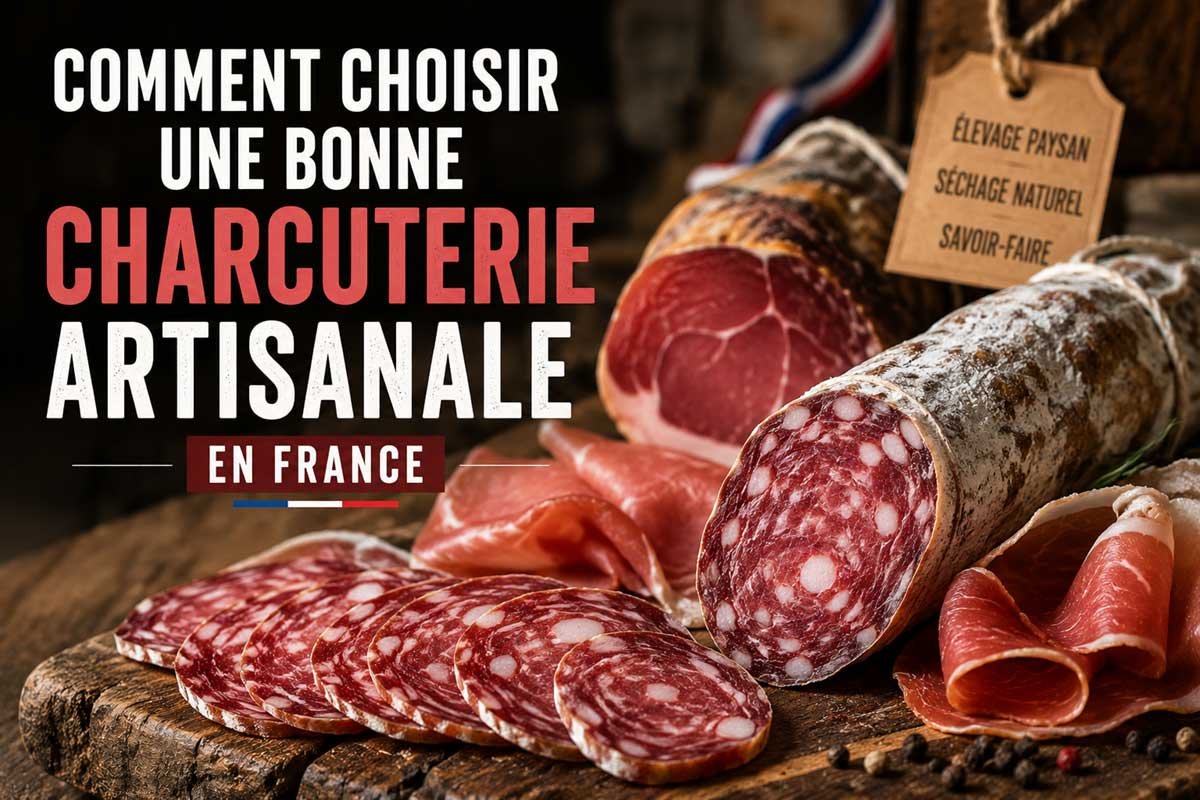
French charcuterie has become a minefield. On the same shelf you find a saucisson at six euros and another at thirty, labels that look almost identical, the word "artisanal" used by industrial brands and small farmers alike, and no real oversight. The term has stopped meaning much. Yet the criteria that separate a genuine farmhouse product from an industrial one are simple, verifiable, and come down to four things: the breed and rearing of the pig, the length of curing, the ingredient list, and the fat-to-lean ratio. This guide explains how to read those signals in practice, and the questions to ask a charcutier so you do not get fooled.
The breed of pig decides almost everything
Before the recipe, there is the animal. A standard industrial pig (Large White, Landrace) slaughtered at six months yields pale, lightly marbled meat with white, flavourless fat. A rustic breed reared outdoors and slaughtered at twelve to fifteen months yields dark, dense meat with creamy, fragrant fat. The breeds that count in France are the Porc Noir Gascon (Gers, Hautes-Pyrénées), the Pie Noir du Pays Basque (Kintoa, AOP since 2017), the Cul Noir du Limousin, the Corsican Porcu Nustrale (AOP since 2012), the Bigorre Noir and the Noir de Bigorre AOP, and increasingly the Mangalica, now reared in Aveyron and Savoie. Asking about the breed is not pedantry. A charcutier who cannot answer is rarely a direct producer.
The other useful question is feed. A pig raised on acorns, chestnuts and cereals (the traditional diet of black pigs) does not produce the same fat as a pig raised on soya-based pellets. Unsaturated fatty acids are more present, the fat melts better in the mouth and does not leave the waxy coating you get from industrial charcuterie.
Long curing is the other tell that cannot be faked
An industrial saucisson is out the door in ten to fifteen days. It is dried in heated chambers, sometimes with bacterial starters and acidifiers to speed ripening. The result holds together in the mouth but stays flat, sour, with no roundness. An artisanal saucisson takes at least four weeks in a natural cellar, and often six to eight weeks for thicker pieces. Mountain saucissons from Auvergne, Cantal, Aubrac or the Aspe valley sometimes need two or three months.
For a dry-cured ham, the scale shifts. A Bayonne IGP requires at least seven months of ageing, a Noir de Bigorre AOP at least twenty months, a Kintoa AOP at least sixteen. Jambon de Lacaune, from the Tarn, runs from twelve to twenty-four months depending on the house. The longer the cure, the more water evaporates, the more concentrated the aromatics become, and the less the salt dominates. A good slice of dry ham should be supple, not brittle, with a fat that chews well and does not coat the palate.
Reading the label: what should be there and what should not
An artisanal charcuterie label is short. Pork, salt, pepper, sometimes garlic, sugar (in small quantity, to feed the curing bacteria), saltpetre (potassium nitrate, E252) or nitrite (E250). That is all. If the list runs to six or seven lines, it is not artisanal.
The warning signs are numerous. Glucose syrups, natural flavourings (or worse, "flavouring"), dextrose, synthetic antioxidants (E300, E301, E316), flavour enhancers (E621), colourings like cochineal carmine (E120) used to give pale meat a pink tint. The salt itself is also a marker. Serious producers write "sel de Salies-de-Béarn", "sel de Guérande", "sel de Noirmoutier" or "sel gemme". The rest just write "salt".
The nitrite debate deserves nuance. Sodium nitrite has come in for serious health criticism over the past decade. But removing it abruptly, without controlling the process, raises the risk of botulism. Some traditional producers do without it entirely (very long-aged hams, very slow-cured saucissons), others use a minimal dose. Industrial "nitrite-free" charcuterie often contains a vegetable broth extract rich in natural nitrates, which convert to nitrites inside the product. The chemistry is the same. The label is just more reassuring.
The fat-to-lean ratio and the cut tell the truth
Industrial charcuterie tends to play down the visible fat to soothe the consumer. The result is dry, flat, joyless. An artisanal saucisson shows the opposite: a clean fat, in white or pearly islands, well distributed, making up thirty to forty per cent of the product. That is not a flaw. It carries the flavour. The fat of a properly fed black pig is firm when cold, melts at mouth temperature, and leaves the mouth coated without feeling heavy.
The cut should be clean, without ragged edges, with the grain of the meat visible (not a uniform paste). A paste too fine, almost pale pink, suggests industrial mincing meant to hide the average quality of the trim. A saucisson sliced by hand by a charcutier lets you see the chunks of fat and lean side by side. It looks better, and it tastes better.
Industrial, semi-artisanal, artisanal: a useful confusion
In French law, "artisanal" is not a protected term for charcuterie. Any production workshop can claim it. In practice three categories exist. Pure industrial (Cochonou, Justin Bridou, Aoste, Madrange) produces at very large scale with forced curing, many additives, and meat blended from several European sources. Semi-artisanal (often regional SMEs bought by large groups) keeps a local-looking face but uses the same accelerators and the same blends. Artisanal producers process meat from a small number of farms, sometimes their own, in natural curing rooms, with short recipes.
The only way to settle it is traceability. An artisanal producer can name the farmers, sometimes the animals, give a slaughter date, name the curing cellar. An industrial one hides behind "origin EU" or "French pork" with no further detail. Listings like Ferme de la Bracadelle in the Aude, which raises its own Gascon black pigs outdoors, or Charcuterie Suc in Paulinet in the Tarn, show what a real short supply chain looks like.
The most overlooked detail: the fat itself
If a single thing had to serve as a test, it would be the fat. Take a piece, rest it on the tongue for five seconds. The fat of an outdoor-reared pig melts almost at once, leaves a taste of hazelnut, sometimes of chestnut, and does not cling. Industrial fat stays solid, waxy, and leaves a greasy film on the palate for minutes. It is the one criterion no marketing can fake. The fat says it all: what the pig ate, how it lived, how long it lived, and how the meat has been worked.
The fat test applies equally to a saucisson, a ham, a rosette, a coppa, a Corsican lonzo or a black pudding. Once you have tasted real, slowly cured black-pig fat, you do not go back. That is also why good charcuterie costs what it does. Three times the supermarket price, sometimes more. But you eat less of it, and differently.
Frequently asked questions
How long is a properly cured artisanal saucisson aged for?
An artisanal saucisson sec is cured for four to eight weeks, depending on diameter and the climate of the cellar. Below three weeks, drying has been forced with heat or industrial ventilation. Mountain saucissons from Auvergne, Savoie or Aveyron often need two to three months for a slow cure in a natural cellar.
Is nitrite-free charcuterie always better?
Not automatically. Sodium nitrite (E250) or potassium nitrite (E249) limits the risk of botulism and stabilises colour. Nitrite-free charcuterie can be excellent when the producer has mastered a long, clean cure, but it has to be eaten sooner. Long-aged traditional dry hams from Bayonne, Lacaune and Corsica often do without nitrite, relying on salt and time.
Where do you find real charcuterie if you have no local butcher?
Three routes. Covered markets that still host farm-based charcutiers. Direct farm sales, often listed by regional chambres d'agriculture. Online shops run directly by producers rather than by middlemen. Épicurieux lists several places, such as Ferme de la Bracadelle, Charcuterie Suc and Nemrod, which ship their own production.
What is a cochon noir and why does it matter?
Cochon noir refers to rustic breeds such as the Gascon, the Basque Pie Noir (Kintoa), the Bigorre Noir and the Cul Noir du Limousin. They grow more slowly (twelve to fifteen months, against six for an industrial pig), live outdoors and produce a much more fragrant marbled fat. That fat is what makes the difference on the plate.
For more, the full selection of charcutiers and farmers listed by Épicurieux sits on the Charcuterie and meat page. Listings such as Ferme de la Bracadelle (Aude), Charcuterie Suc (Tarn) and Nemrod (Alsace) show what a real short supply chain produces. Know a place worth recommending? The contact page is open.