Home › The journal › How to recognise quality chocolate
How to recognise quality chocolate (and avoid the fakes)
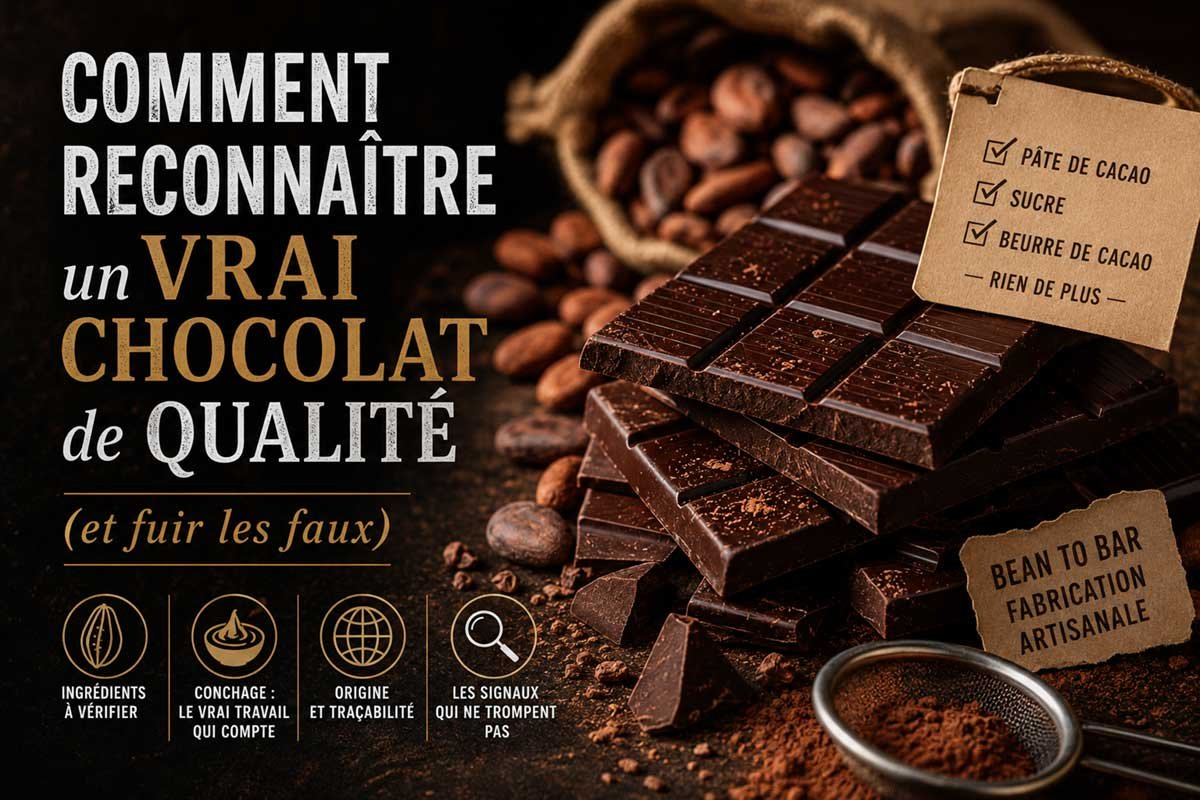
The chocolate aisle has become illegible. A three-euro bar stamped grand cru, pralinés in a gilded box at twenty euros for a hundred grams, industrial brands rebadging themselves bean-to-bar without doing the work. The words "artisanal" and "70 per cent cocoa" have been emptied of meaning. Telling a real chocolate from a faked premium one still takes a few seconds though: a glance at the label, a snap test, a taste. This article runs through what really counts (ingredients, conching, origin, storage) and what is just marketing.
The label: three lines are enough to judge
A good dark chocolate contains exactly three ingredients: cocoa mass, sugar, cocoa butter. Sometimes a little natural vanilla (pod, not vanillin). Sometimes nothing else. If the label adds vegetable fats (palm, shea, illipe, sal, kokum), that is a bad sign. The European directive has allowed up to 5 per cent vegetable fats as a cocoa butter substitute since 2000, and the supermarket trade leans on it. Cocoa butter is expensive (around 8 to 10 euros a kilo), vegetable fats cost a quarter of that. A chocolate containing them melts less cleanly, smells less, sticks more.
Soy lecithin (E322) is tolerated but remains a compromise. It makes industrial production easier by thinning the chocolate. A serious bean-to-bar maker does without it, or uses sunflower lecithin. Vanillin (synthetic flavouring) should ring the same warning bell. A pod of Madagascar vanilla costs 30 euros a kilo, vanillin costs 15 euros a tonne. A chocolatier who cuts corners on vanilla is probably cutting corners elsewhere too.
For milk chocolate the composition gets more complicated, but the principle holds. Cocoa mass, sugar, whole-milk powder, cocoa butter, natural vanilla. No skimmed-milk powder (which thins the roundness), no palm oil, no added flavourings. The best artisanal milk chocolates climb to 40 or 45 per cent cocoa, where the industrial ones stay at 25 or 30.
Conching: the invisible work that makes the difference
Conching is the prolonged kneading stage that follows the grinding of the beans. Invented by Rodolphe Lindt in 1879, it aerates the paste, drives off volatile acids, balances the aromatics and smooths the texture. An industrial conche runs for six to eight hours. A serious chocolatier's conche runs between 24 and 72 hours. The most exacting bean-to-bar makers go to 96 hours for certain origins.
Short conching shows itself in several ways. The paste feels gritty in the mouth, sugar crystals come through, acidity stays aggressive (vinegary notes, sharp citrus), a dry bitterness lingers after the tasting. Long conching gives a silky paste, a noble bitterness that fades within seconds, secondary aromas (red fruit, honey, tobacco, wood) that unfold gradually. It is a difference no percentage on the wrapper can show.
Bean-to-bar, chocolatier, confiseur: three different trades
The confusion between these terms is kept alive. A bean-to-bar chocolate is made entirely by the producer, who selects the beans, roasts them, cracks them, grinds them, conches them and moulds them. France has only a handful: Le Chocolat Alain Ducasse, Pralus, Bonnat, Bernachon (Lyon), Encuentro, Plaq, Beau Cacao. Most of them buy their cocoa directly from producer cooperatives.
A traditional chocolatier buys couverture chocolate (from suppliers such as Valrhona, Cacao Barry, Michel Cluizel, Weiss, Belcolade) and turns it into sweets, ganaches, pralinés and house bars. It is a craft of assembly and finishing, not of making chocolate from scratch. There is nothing wrong with that. An excellent chocolatier knows how to choose couvertures and marry them. But they do not make their chocolate. When the words "bean-to-bar" appear without a visible roastery behind them, it is probably untrue.
A confiseur, finally, turns already-finished products (chocolates, fruit pastes, caramels) into assortments. Many shops calling themselves "chocolatier" are in fact confiseurs rebadging industrial couverture in a luxury box. The simple test is to ask which couverture is used, and why. A precise answer (origin, brand, percentage, reason for the choice) gives away a real professional.
The rebadged couverture trap
This is the most common scam in the mid- and upper market. A maker buys slabs of couverture (industrial chocolate destined for the trade) from Valrhona, Cacao Barry or Cémoi, melts it down, pours it into a logoed mould, wraps it in a screen-printed paper, and sells for fifty euros a kilo what cost twelve to buy in. The chocolate is fine (Valrhona Caraïbe is decent), but it has nothing unique or house-made about it. The clues: no precise origin given for the cocoa, generic vocabulary ("intense dark", "grand cru"), no production date, careful packaging but a thin ingredient list.
Visual cues: what the bar tells you before you taste it
Before tasting, look. A quality bar should show a deep reddish-brown colour, almost mahogany, never the chocolate-brown of advertising nor a charcoal black. A uniform surface, no micro-bubbles, no white streaks, no deposits. A clean shine (matt everywhere signals bad tempering). A sharp, dry break, with that distinctive snap when you split the bar. If the break is soft or crumbly, cocoa butter is missing or the temper has gone wrong.
Bloom is another indicator. Sugar bloom (caused by humidity) leaves grainy white patches. Fat bloom (caused by heat) leaves a smooth grey-white film on the surface. Neither makes the chocolate unsafe, but both indicate poor storage, sometimes in the shop itself. A bloomed bar bought new is a poor sign for the seller's stock turnover.
Cocoa origins that matter
Cocoa is grown in a narrow equatorial belt. The origins known for quality are few. Madagascar (red fruit, citrus, tart berries), Peru (balance, dried fruit, hazelnut), Ecuador (the aromatic, floral Nacional bean), Venezuela (once the absolute reference, now in political decline), Tanzania (Kokoa Kamili, red fruit, coffee), Vietnam (rich Trinitario, sometimes spiced), São Tomé (powerful, earthy), the Dominican Republic (balanced, accessible).
Ghana and Côte d'Ivoire supply the bulk of the world's cocoa, but mostly in the Forastero variety: hardier, more bitter, less fragrant. That is the cocoa industry uses. Grand cru chocolates use Criollo (rare, fragile, expensive) or Trinitario (a hardier cross, with aromatic balance). A chocolate that mentions neither variety nor a precise country of origin is probably an anonymous blend.
Tasting: what you are looking for
Bring the chocolate out of the fridge an hour ahead. Break off a square, place it on the tongue, let it melt without chewing. A good chocolate takes between twenty and forty seconds to melt fully, releases three stages of flavour (attack, mid-palate, finish), and leaves a length on the palate of at least thirty seconds. A poor chocolate melts fast, opens with sugar, finishes short and without nuance.
The useful vocabulary is concrete. Red fruit (Madagascar), citrus (Ecuador), dried fruit and wood (Peru), spice (Vietnam), coffee and caramel (Tanzania), tobacco and leather (Venezuela). The bitterness should be fine and fleeting, not dry. Acidity should be present but rounded. Sugar should sit behind the cocoa, never in front of it. If a tasting comes down to "sweet and chocolatey", it is industrial chocolate.
Frequently asked questions
What is the ideal cocoa percentage for a good dark chocolate?
There is no magic number. A good dark chocolate sits between 65 and 75 per cent. Below 60 per cent, sugar dominates. Above 80 per cent, you lose roundness and amplify any flaws in the bean if it is not excellent. The percentage matters less than the quality of the cocoa, the conching, and the absence of vegetable fats.
Is dark chocolate really better than milk chocolate?
Better, no. Different. An excellent milk chocolate can be more complex than a mediocre dark. Milk chocolate mostly suffers from industrial brands that load it with sugar (often 50 per cent) and flat milk powder. An artisanal milk chocolate at 40 to 45 per cent cocoa, made with good whole-milk powder, can be remarkable.
How do you store chocolate so it does not bloom?
Between 16 and 18 degrees, somewhere dry, away from light and strong smells (cocoa absorbs everything). Not in the fridge (humidity causes sugar bloom). Not next to the oven or a sunny window (cocoa butter migrates and produces fat bloom). An airtight tin in a cool cupboard works perfectly well.
What is tempering and why does it matter?
Tempering is the control of cocoa butter crystallisation during moulding. The chocolate is heated, cooled, then re-warmed along precise curves (around 50, 28 then 31 degrees for dark) to lock in a single crystal form. A well-tempered chocolate snaps cleanly, shines, does not melt in the fingers and keeps without blooming. A badly tempered chocolate looks dull, feels soft, sometimes grainy.
The selection of chocolatiers and confiseurs we list sits on the Chocolate and confectionery page. Listings such as Guy Roux Chocolatier (Occitanie), Abbaye de Bonneval (Aveyron) or Sanhes (a farm-based ice-cream maker in Aveyron) show what serious chocolate work looks like. Know a shop worth flagging? The contact page is open.