Home › The journal › Brittany: the best places for food and drink
Brittany: the best places for food and drink
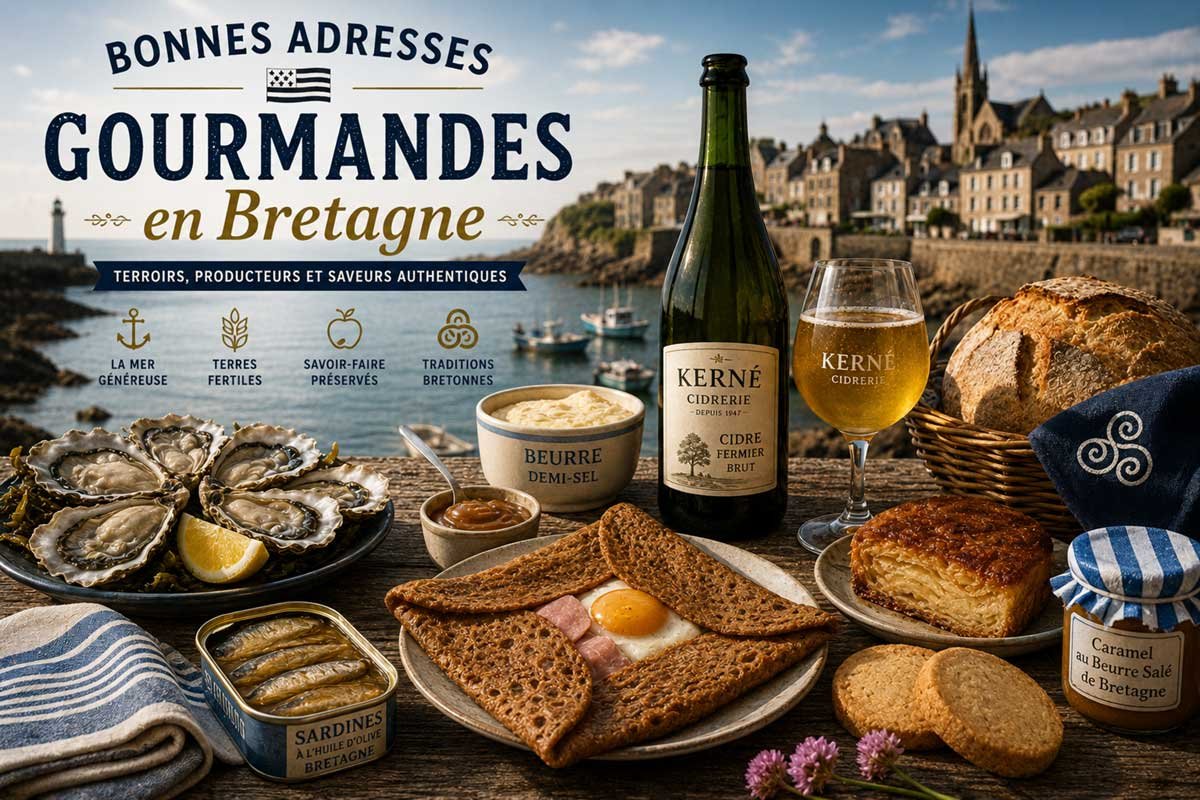
Brittany is eaten by way of the sea and by way of butter. Twelve hundred kilometres of coastline, islands, estuaries, heath and bocage, and behind it all a farming hinterland that has fed the country for centuries. Crêpe, galette, cidre, salted butter, tinned sardines, kouign-amann. The Breton vocabulary is familiar to everyone. The region still remains one of the least represented in our current selection, and this dossier is also an invitation. Brittany is worth going to look for.
The region's food identity
Breton cooking was built against hardship. Acid soils, a windy climate, wet winters. For centuries, buckwheat saved the region. Grown where wheat would not, it gave rise to the galette, daily fare for a numerous peasantry. Butter came from a dairy industry that shaped the inland country. Salted for preservation, it became a marker of identity, to the point that Brittany is the only major French region that still serves its bread with salted butter without a second thought.
The sea did the rest. The fishing ports of Douarnenez, Concarneau, Lorient and Saint-Guénolé feed a canning industry which, since the nineteenth century, has turned sardines and mackerel into tabletop products of real quality. Inshore fishing, shellfish, seaweed, and more recently spirulina, sketch a maritime economy that modernises without disowning its origins. The schist and granite soils, ill-suited to vines but ideal for apple trees, explain the place of cider. And the Celtic tradition has kept chouchen, a mead made from apples and honey, a steady presence that never quite disappeared.
The signature products
Hard to rank them. Salted butter first, found in the dairy cooperatives of Finistère and the Côtes-d'Armor. Buckwheat galettes, whose recipe is codified by the IGP Farine de blé noir Tradition Bretagne. The kouign-amann from Douarnenez: simple butter, sugar and dough, but a technical discipline that defeats most amateurs. The dense, upright far breton. The plainer gâteau breton. The lace pancakes of Quimper. The salted-butter caramels from Henri Le Roux, in Quiberon, who invented the genre in the 1970s.
For charcuterie, the andouille of Guéméné, smoked then poached, is a high point. For vegetables, the AOP Coco de Paimpol bean, the IGP pink onion of Roscoff, the Breton artichoke, the strawberry of Plougastel, ripening as early as April along the Atlantic. For seafood, the oysters of Cancale and Belon, the scallops of the Bay of Saint-Brieuc, blue lobster, line-caught sea bass, fresh sardines in June. For drink, farmhouse cidre in its three main styles (sweet, medium-dry, dry), lambig (a cider eau-de-vie) and chouchen. Brittany has no wine of its own, but it distils and ferments with finesse.
Seasons and markets to know
Brittany rewards visits at any time of year, though each product has its window. March to May: the first gariguette and Mara des bois strawberries, sandy-soil asparagus, the first sardines. May to July: artichaut camus, new Paimpol coco beans, oysters still fleshy. July and August: vegetables and red berries, but crowded markets. September to November: oysters back in their full briny form, scallops at the start of the season, the first cider apples, new lambig. December to February: peak season for scallops, oysters and Breton cauliflower.
On the market front, Vannes on Wednesday and Saturday, Quimper on Wednesday morning and Saturday, Saint-Brieuc on Saturday at the place de la Résistance, Dinan on Thursday, Concarneau on Friday, Lorient on Wednesday and Saturday at Merville. Breton markets stay lively even out of season, which makes them one of the best ways to approach the region.
Our Épicurieux finds
The only Épicurieux address in Brittany today is Kerné, a long-standing cider house in Pouldreuzic, in the Pays Bigouden, making farmhouse cider since 1947. Three generations, apples from Finistère, a cider raised without haste, which sets the benchmark for what a Breton cider should be. The house offers visits and tastings, and remains an ideal way into Breton cider as a subject.
Brittany has a great deal more to offer, and our selection needs to grow. Butter-makers, sardine canneries, buckwheat breweries, cider houses of the Trégor and the Breton Cotentin, traditional biscuit makers, the salt pans of Guérande, oyster farmers in Cancale and on the Belon river, seaside ice-cream makers, chocolatiers of Saint-Malo. If you know a trusted address in Brittany, whether family-run, smallholder or artisanal, tell us. Share your finds: that is how the guide is built.
To go further
While the selection fills out, our drink and eat categories let you explore France by product rather than by region. The interactive map, filtered by region, will give a fairer reading of Épicurieux Brittany in a few months. Until then, a loop from Quimper to Pouldreuzic, Douarnenez and Concarneau is still one of the finest food circuits in Finistère.
Frequently asked questions
When is the best season to discover Brittany for food and drink?
Autumn and early winter, September to February, remain the best compromise. Shellfish are at their peak, oysters recover after summer, the cider apple is pressed, and markets keep their character once the holiday crowds have gone.
Which Breton product is the most underrated?
The andouille of Guéméné. Avoided by many for its assertive aroma, it is nonetheless one of the most complex pork products in France, smoked and sewn by hand according to a craft now under threat.
Can cider houses, canneries and farms be visited?
Yes. Most cider houses in Finistère and Ille-et-Vilaine welcome visitors. The canneries of Douarnenez, Concarneau and Quiberon also run tastings. Book ahead in high season.
Where can Breton products be bought outside the region?
Artisan canned goods (sardines, fish rillettes, soups) are widely stocked in good delicatessens. For AOP Breton butter, farmhouse cider and kouign-amann, direct online sales from the producer remain the most reliable route.
Which AOP and IGP labels structure Breton cooking?
Beurre Charentes-Poitou at the edges, AOP Beurre de Bretagne pending, IGP Farine de blé noir Tradition Bretagne, IGP Cidre de Bretagne, AOP Coco de Paimpol, IGP Oignon de Roscoff, IGP Volailles de Janzé. The territory is also shaped by regional marks and the Label Rouge.
Brittany is still a region for Épicurieux to explore. The density of smallholders, the vitality of family-run canneries, the new generation of cider makers and buckwheat brewers all point to a rich future selection. It will come. For now, Kerné sets the tone, and we are counting on readers to open other doors.