Home › The journal › Provence-Alpes-Côte d'Azur: places for food and drink
Provence-Alpes-Côte d'Azur: places for food and drink
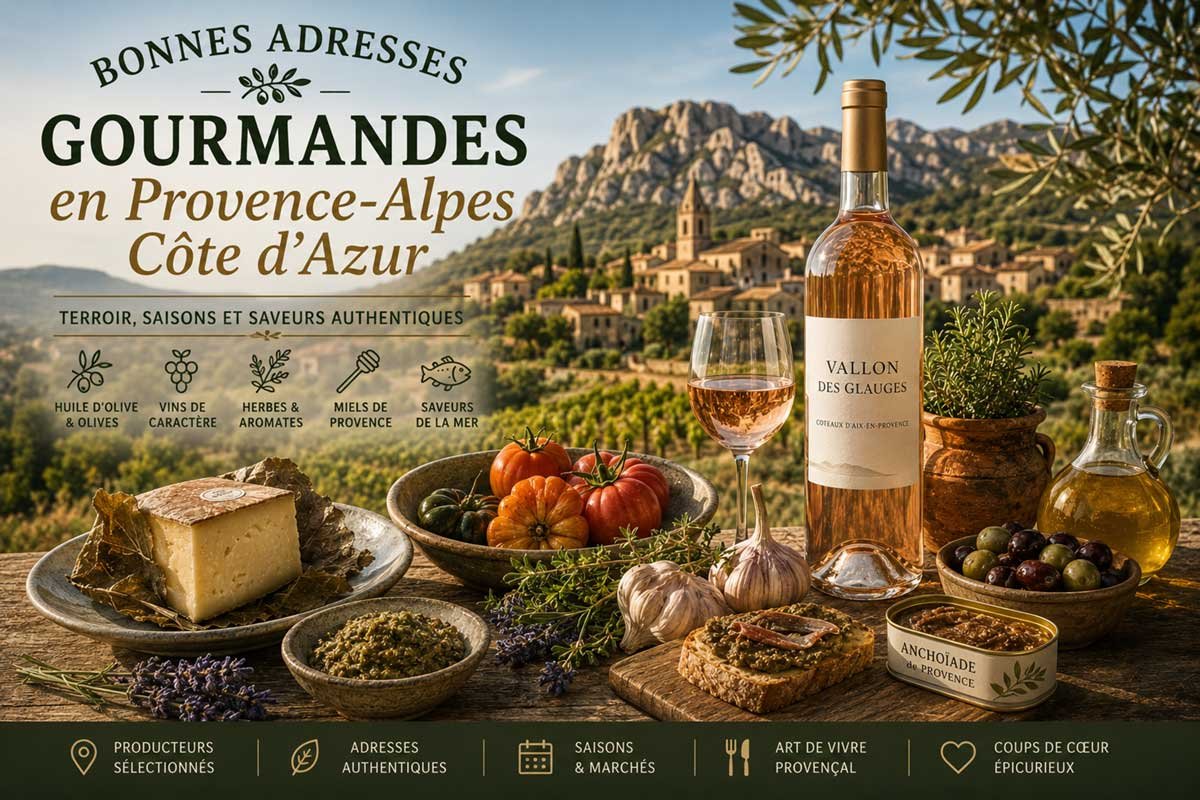
Provence is eaten in a low voice. A drop of olive oil, a little fleur de sel, a tomato picked at the right moment. The south-east of France has invented a cooking of the sun that the rest of the world copies without always grasping its precision. Vegetables, herbs, oil, wine, rockfish. Our PACA selection is modest for the time being, and this dossier sets out both the scene and the invitation. Provence-Alpes-Côte d'Azur is a region that rewards time spent on it.
The region's food identity
Six départements, three worlds. The coastline between Marseille and Menton, which speaks of garlic, anchoïade, fish and chilled rosé. The Var hinterland and inland Provence in the Bouches-du-Rhône, which speak of vines, olives, lamb and thyme. Haute-Provence, the Verdon and the Préalpes, which speak of honey, petit épeautre, lavender, Sisteron lamb and goat's cheese. This vertical layering produces a kitchen of rare variety, organised as much by altitude as by sea.
The soils tell the same story. Hard limestones of the Calanques and the Alpilles, schist of the Maures, sandstones of the Vaucluse, marls of the Verdon. The Mediterranean climate, shaped by the mistral, summer drought and autumn rain, gives fruit of concentrated flavour. A Provence tomato has different flesh from a Sologne one. A Bandol grape has none of the freshness of a Sancerre. That concentration is what defines the table.
Historically, the region lived off the great trade routes. Marseille imported spices, salted fish, citrus and culinary techniques from Italy, the Maghreb and the Levant. Bouillabaisse, aïoli, pissaladière and the niçois socca are dishes born of those exchanges. The pistou comes straight from Ligurian pesto, brought across and then claimed by Nice and central Provence.
The signature products
Olive oil first. Six AOPs cover the region (Provence, Aix-en-Provence, Baux-de-Provence, Haute-Provence, Nice, Nyons on the border), with sensory profiles that run from green, grassy fruité vert to evolved fruité noir. It is one of the only French territories to produce both. Wines next: Bandol (mourvèdre), Cassis (clairette and marsanne), Bellet (rare grape varieties around Nice), Coteaux d'Aix-en-Provence, Côtes de Provence, Baux-de-Provence. Rosé has become the region's signature worldwide, but the reds of Bandol and the whites of Cassis deserve at least as much attention.
For charcuterie and meat, IGP Sisteron lamb, daube provençale, the Marseille pieds-paquets. For vegetables, the tomato of nearby Marmande, the long Nice courgette, the violet artichoke, chard, pink garlic, Picholine and Tanche olives. For cheese, AOP Banon wrapped in its chestnut leaf, AOP Brousse du Rove eaten with a spoon and a thread of honey. For sugar, the calisson of Aix, the navette of Marseille, the Carpentras berlingot, quince paste, black and white nougat. For seafood, scorpionfish, conger, John Dory, Mediterranean sardines, and the cured mullet roe of Martigues.
Honey deserves a paragraph of its own. IGP Miel de Provence, lavender honey, rosemary honey, garrigue honey, chestnut honey in the Var, fir honey in the Hautes-Alpes. No other region of France offers such a spread of honeys.
Seasons and markets to know
March to May: Vaucluse asparagus, Carpentras strawberries, the first violet artichokes. May to July: the full market season: heirloom tomatoes, courgette flowers, Vaucluse apricots, Cavaillon melons. July and August: busy and crowded for visits, but also the peak for fresh herbs and basil. September to November: harvest, the first green olives picked around mid-October, game in Haute-Provence, the first black truffles in the Vaucluse from November. December to February: peak season for truffles at Aups and Richerenches, the first milk-fed lamb and slow-cooked dishes.
For markets, Aix-en-Provence on Tuesday, Thursday and Saturday at the place des Prêcheurs, Apt on Saturday, L'Isle-sur-la-Sorgue on Sunday, Lourmarin on Friday, Forcalquier on Monday, Nice on the cours Saleya every day but Monday, Carpentras on Friday, and Richerenches on Saturday from November to March for the truffle. These are observation points as much as shopping runs.
Our Épicurieux finds
The only Épicurieux address in Provence-Alpes-Côte d'Azur today is the Vallon des Glauges, a wine estate at Eyguières, at the foot of the Alpilles, on the AOP Coteaux d'Aix-en-Provence and Baux-de-Provence land. A family domaine run with real agronomic rigour, it makes red, white and rosé wines that sum up what Provence can do well: elegance, freshness, energy. Estate visits and the tasting cellar are a good way in to local viticulture.
The region has far more still to discover, and our selection needs building. Oil mills of the Baux-de-Salon and the Vallée des Baux, domaines of Bandol and Cassis, calisson makers of Aix, Marseille biscuit houses, poutargue producers at Martigues, the honey-maker of Forcalquier, Banon cheesemakers, lavender distillers, traditional soap makers, Nice ice-cream makers. If you know a trusted address in Provence, in the southern Alps or on the Côte d'Azur, smallholder, artisan or family-run, tell us. Share your finds: the PACA selection is written with you.
To go further
While the selection fills out, our winemakers, spices and condiments and bed & breakfasts categories give another way in. A weekend along the Alpilles road, from Saint-Rémy-de-Provence to Maussane, Les Baux and Eyguières, is one of the finest introductions to Provence at the table. Add Aix-en-Provence, Cassis and Bandol and you have a coherent week.
Frequently asked questions
When is the best season to discover Provence for food and drink?
Late spring and early autumn. April to June for asparagus, the first strawberries and the last of the new oil. September to November for the harvest, the green olive pick and the first game.
Which Provençal product is the most underrated?
Olive oil from the Vallée des Baux. An exacting AOP, both ripe-fruited and black-fruited, it remains overshadowed by the more publicised oils of the Mediterranean. Tasted on grilled bread, it speaks for itself.
Can wine estates and oil mills be visited?
Yes, and it is the best way to approach the region. Domaines in Bandol, Cassis, Bellet, Coteaux d'Aix, Baux-de-Provence and Côtes de Provence offer tastings. Mills in the Vaucluse and the Bouches-du-Rhône welcome visitors, especially during the olive season.
Where can Provençal products be bought outside the region?
Provence wines are widely distributed. Olive oil, tapenades, honeys and calissons are stocked in fine grocers or sold directly from the producer. For more confidential items (poutargue, navette, taillé aux pignons), buying online is the simplest route.
Which AOP and IGP labels structure Provence at the table?
AOP Bandol, AOP Cassis, AOP Bellet, AOP Coteaux d'Aix-en-Provence, AOP Baux-de-Provence (wine and oil), AOP Huile d'olive de Provence, AOP Banon, AOC Brousse du Rove, IGP Miel de Provence, IGP Agneau de Sisteron, IGP Petit Épeautre de Haute-Provence.
Provence-Alpes-Côte d'Azur remains, for Épicurieux, a region to open up. The density of wine estates, the depth of olive cultivation, the vitality of the hinterland and the finesse of niçois cooking all point to a selection that asks to grow. For now, Vallon des Glauges sets a bearing. The rest is for readers to point us towards.
View all Provence-Alpes-Côte d'Azur places on the map ← Back to the journal