Home › The journal › A French food calendar, month by month
A French food calendar: what to eat, month by month
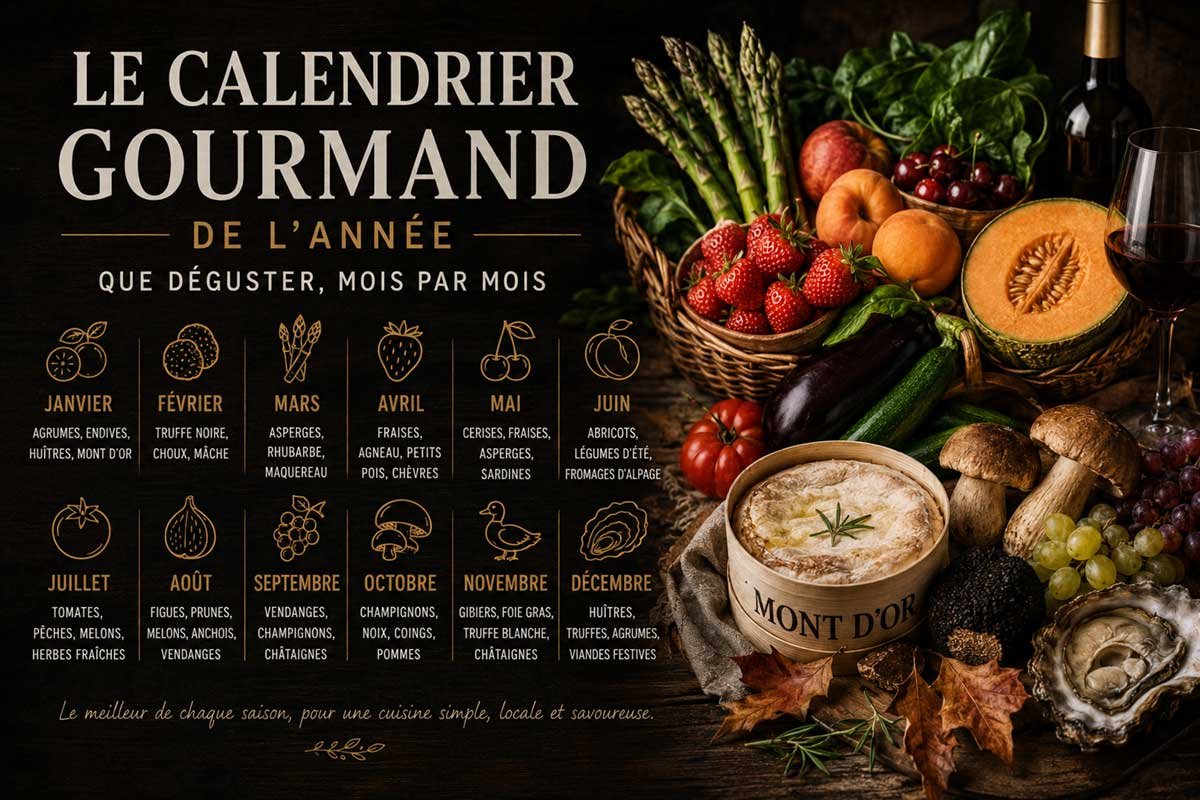
France is fortunate to have a wide and varied food calendar. Each month brings its own arrivals. The first radishes of spring. Field-grown tomatoes at the height of summer. Game coming back in September. Oysters and truffles in December. And yet, on the shelves, everything seems available all year. Tomatoes in January, asparagus in November, strawberries at Christmas. This calendar offers a simple bearing. Month by month, here is what is worth your attention on the markets, with producers and in good houses. It is also a starting point for cooking better, spending less, and supporting local production.
January
The month of roots and citrus. Endives, carrots, parsnips, Jerusalem artichokes and salsify dominate the markets. It is also the height of Corsican citrus: Clémentine de Corse IGP, citron, mandarin. From the sea, the scallop from the bay of Saint-Brieuc is at the peak of its form. For cheese, Mont d'Or du Haut-Doubs is still there, to be spooned out warm after a night in the oven. Oysters benefit from the cold to gain in finesse. January is also the month of the galette des Rois, the frangipane and the hidden charm inside.
February
February prolongs the winter but already hints at spring. Citrus stays excellent, brassicas too: cabbage of Pontoise, kale, Breton cauliflower. Mâche nantaise IGP is at its best. It is still the season of the truffe noire du Périgord, Tuber melanosporum, through to late March. The truffle markets of Lalbenque, Richerenches and Sarlat are in full swing. On game, the season closes at the end of February. The last month also for Mont d'Or. Candlemas duly calls for pancakes by the dozen.
March
March marks the turn. The first asparagus arrives in the south, at Mormoiron, in the Gard and the Vaucluse. Pink radishes return. Spinach, chard, and the first rhubarb appear. On drinks, this is the moment to open a Jura vin de paille, made from grapes raisined on straw mats. Fresh goat's cheeses begin their season after kidding. For fish, line-caught mackerel is excellent in March. And spring markets reopen across France.
April
April is the month of white asparagus from the Landes IGP and green asparagus from the Gard. The gariguette strawberry arrives in Provence and the Lot-et-Garonne. The first peas, fresh broad beans and purple Roussillon artichokes are back. For lamb, it is Easter: agneau de pré-salé from the bay of Mont-Saint-Michel AOP, Sisteron lamb IGP. Fresh goat's cheeses are in full swing: crottin de Chavignol, picodon, rocamadour. April is also the great return of open-air markets.
May
May is short and intense. Asparagus reaches its peak across the country. Strawberries explode: gariguette, ciflorette, charlotte. The first cherries of the Rhône valley, burlat then napoléon, open the red season. Radishes, baby turnips, mangetout are at their best. From the sea, Breton sardines come back. On wine, it is primeur tasting time in the Languedoc and Roussillon. And the Mâcon wine fair, in May, remains a historic date.
June
June opens summer. Apricots from the Roussillon and the Drôme arrive. The first field-grown tomatoes appear in the south. Courgettes, aubergines, peppers and cucumbers fill the stalls. It is the height of the raspberry, redcurrant and blackcurrant. The cherry hits its peak. For cheese, alpine production begins: Beaufort d'été AOP, farm Abondance. From the sea, line-caught Atlantic sea bass is superb. The Feast of Saint John, on 24 June, remains a regional culinary landmark.
July
July is the month of tomatoes. Cœur de bœuf, noire de Crimée, green zebra, ananas... every heirloom variety is here. Peaches and nectarines from the Roussillon, melons from Cavaillon, early white figs come in. Green beans, courgette flowers, peppers are at their best. Provence rosé sits well alongside all of it. The night markets of the Sud-Ouest and Provence are at full pitch. July is also the season of grilling, of the barbecue, of simple cooking.
August
August extends the summer abundance. The Cavaillon melon IGP, the figue de Solliès AOP and plums (mirabelle de Lorraine IGP, reine-claude, quetsche) are at their peak. The first wild blackberries and the first hazelnuts appear. It is also the season of herbs: basil, tarragon, savory. From the sea, the anchovy of Collioure is being salted. On wine, early harvests begin in the Roussillon and Languedoc from mid-August for whites and rosés. The festival of Saint-Louis at Sète, at the end of August, is memorable.
September
September is the great return. The vendanges are in full swing across France: Bordeaux, Bourgogne, Champagne, Alsace, Loire. The general opening of large game falls on the second Sunday of September: wild boar, roe deer, red deer. The cep season in the Périgord and Limousin begins after the first rains. The first chestnuts of the Cévennes AOP fall. Figs, table grapes (Chasselas de Moissac AOP, Muscat du Ventoux AOP) and the first Grenoble walnuts AOP arrive. The Colmar Alsatian wine fair remains an unmissable date.
October
October is the golden month. Ceps, chanterelles, hedgehog mushrooms and black trumpets are at their height. Walnuts, hazelnuts and chestnuts fill the baskets. Quinces, apples (reinette du Mans, calville) and pears (comice, conference) return. Hunting on horseback opens. For cheese, farm Reblochon de Savoie AOP and Époisses de Bourgogne AOP are at their best. On wine, autumn fairs spring up everywhere. And the scallop is back in service from 1 October in the Channel.
November
November is the month of game. Hare, pheasant, partridge, roe deer, wild boar... feathered and furred game is everywhere. The scallops of the bay of Saint-Brieuc and the Cotentin are superb. Oysters reclaim their place on the markets. Mont d'Or du Haut-Doubs AOP reappears. The first black Périgord truffles arrive. It is also the release of Beaujolais nouveau, the third Thursday of November. On vegetables, the first Lyon cardoons and Jerusalem artichokes return to the baskets.
December
December is the month of the table. Oysters of Marennes-Oléron IGP, of Cancale, of Bouzigues. Foie gras du Sud-Ouest IGP. Black Périgord truffle. Smoked salmon, scallops, Breton lobster. Chapon de Bresse AOP, dinde fermière des Landes IGP. The Christmas markets of Alsace, in Strasbourg and Colmar, are obligatory stops. Mont d'Or flows in volume. On wine, bottles are pulled: Champagne, Bourgogne, Sauternes with foie gras, Banyuls with chocolate. December is the month in which the French terroir opens out fully.
The pleasure of the season
Eating seasonally is not a pose. It is a question of taste first. A July tomato has nothing to do with a February one, grown under heated glass and picked green. A May strawberry carries a scent a December strawberry simply cannot have. It is a question of price next. A product in full season is plentiful, therefore cheaper. Out of season you pay for transport, heating, storage. It is a question of the environment last. Heated glasshouses for off-soil growing burn through energy. Air-freighted fruit and vegetables carry a disproportionate carbon footprint. Backing French and local supply means backing farmers, terroirs, and craft. For more, browse our selections of artisanal charcutiers, farm cheesemakers, and independent winemakers. Or follow the map to find good houses near you.
Frequently asked questions
When do French strawberries end?
The main French strawberry season runs from April to July, depending on the variety. Gariguette opens proceedings as early as April in the south. Charlotte and Mara des Bois take over until July. After that, supermarket strawberries are usually Spanish, Moroccan, or grown in heated glasshouses.
Can you eat oysters in summer?
Yes. The old rule about months with an R has been obsolete since the rise of triploid oysters and the improvement of the cold chain. In summer, oysters are spawning: they turn milky. That is a question of taste, not safety. Connoisseurs often prefer the cold months for firm, briny flesh.
When are wild mushrooms at their best?
Autumn, from September to November. Ceps emerge after the late-summer rains. Chanterelles start as early as July and hold through October. Black trumpets and hedgehog mushrooms appear in October. The morel is the exception: a spring mushroom, April to May.
Do you really need to avoid meat out of season?
For farmed meat, no. For game, yes: hunting is tightly regulated. Large game opens in September and closes at the end of February. Outside that window, what you find in a butcher's is either farmed game or imported. The flavour is not the same.
Which cheeses are actually seasonal?
Alpine cheeses (summer Beaufort, Abondance, farm Reblochon) are made in summer, when cows go up to the high pastures. Mont d'Or arrives in September and disappears in May. Fresh goat's cheeses are at their best from spring to autumn, when the goats are in milk. In winter, many goat herds are dry.
The French food calendar is a bearing, not a strict rule. It is about rediscovering the pleasure of waiting. The first asparagus of March. The first tomato of July. The first oyster of autumn. They are appointments. And they are worth keeping.