Home › The journal › A craft beer glossary
2026-05-18
A craft beer glossary: IPA, stout, lambic...
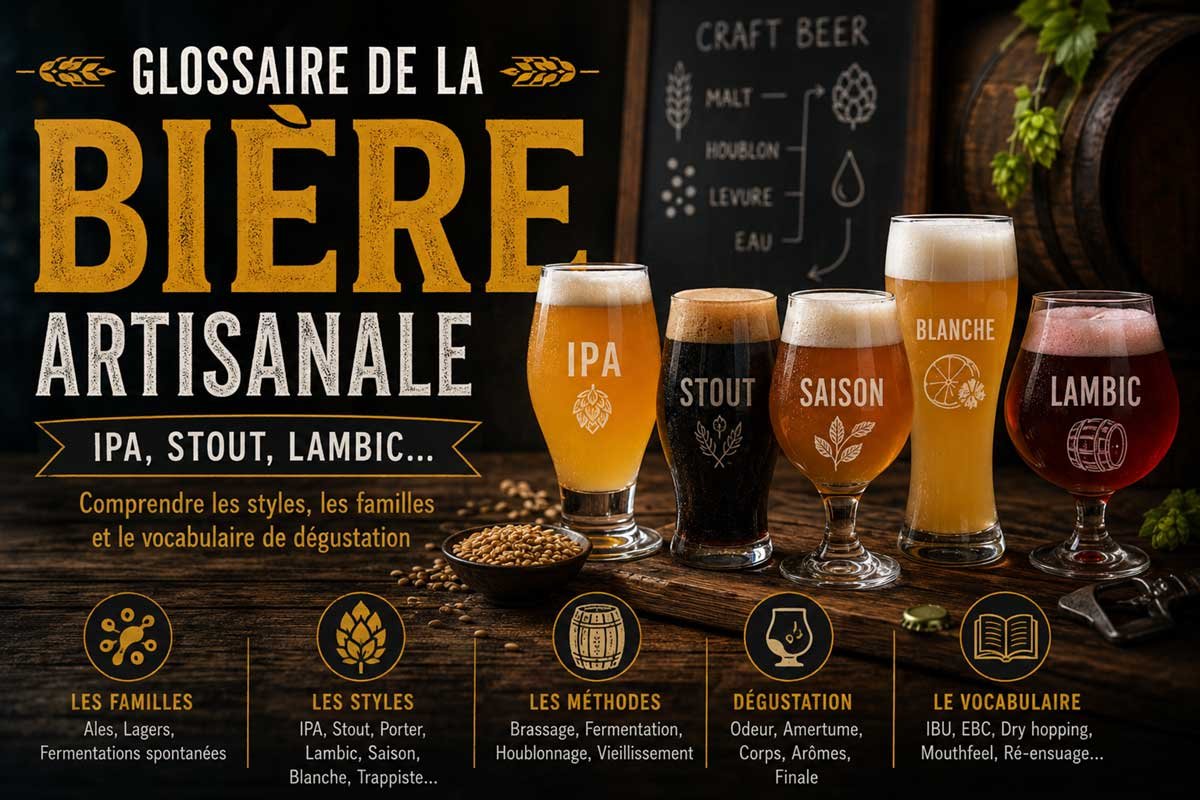
The French brewing scene has exploded since 2010. In fifteen years or so, the country has gone from a few dozen breweries to a very dense landscape, and the vocabulary that comes with it has grown thick. Bar menus offer a double IPA, a hoppy saison, a barrel-aged imperial stout, a cherry lambic. The curious drinker no longer always knows what they have ordered. This glossary is here for that. Not an encyclopaedia, not a brewer's manual... a set of reference points. The main families first, the styles after, the tasting vocabulary at the end. Enough to read a menu with a little more confidence, choose without feeling cornered, and start to understand why two pale beers can have nothing in common.
The main families
The first distinction is the family of yeast. Everything else flows from it.
Ales are brewed with top-fermenting yeasts. They work at relatively warm temperatures, between 15 and 24 °C, and rise to the surface of the tank during fermentation. They produce fruity and spicy aromas, and give a rich aromatic profile. Most modern English, Belgian and American styles are ales: IPA, stout, porter, blonde de garde, saison, witbier, Trappist, sour.
Lagers use bottom-fermenting yeasts, which ferment slowly in the cold (between 7 and 13 °C) and stay at the bottom of the tank. They produce cleaner, drier beers with a discreet aromatic profile. Pilsner, helles, bock and märzen belong to this family. It is also, by default, the family of large industrial beers... but a well-made craft lager is a precise and demanding exercise.
Spontaneous fermentations form a third path. Neither cultured yeast nor added yeast: the beer is seeded by the micro-organisms in the air. This is the territory of Belgian lambic, gueuze, and a few recent French experiments.
Style by style
IPA (India Pale Ale)
Born in England in the nineteenth century to survive the voyages to India, revived by the American west coast in the 1990s, since then the flagship style of the global craft beer movement. The IPA is an amber to golden ale, generously hopped, between 5.5 and 7.5% alcohol, with marked bitterness and a very expressive aromatic profile. American hops (Citra, Mosaic, Simcoe) bring notes of citrus, tropical fruit, pine and resin. Common substyles: West Coast IPA (dry, clear, very bitter), New England IPA (hazy, rounded, juicy, low in bitterness), Double IPA (stronger), Black IPA (dark), Session IPA (lighter).
Stout
A black beer of Irish origin, brewed with roasted malts that give its opaque colour and notes of coffee, cocoa, liquorice and burnt bread. A dry stout, like Guinness, is surprisingly light on the palate, around 4 to 5% alcohol. Modern variations enrich it: Milk Stout (sweet, with lactose), Oatmeal Stout (smooth, with oats), Imperial Stout (powerful, 8 to 12% alcohol, often aged in whisky or bourbon barrels). Imperial stout is one of the few styles that genuinely improves in the bottle over several years.
Porter
The stout's historical cousin, older, long confused with it. Porter is dark brown rather than black, brewed with less roasted malts, and remains rounder and less austere. You find cocoa, caramel, sometimes a smoky touch. The strength sits around 5 to 6% alcohol. It is an ideal transition beer for anyone wanting to discover dark beers without jumping straight into the intensity of an imperial stout. French brewers often work it with local malts that give it a particular grain and softness.
Lambic and gueuze
Lambic is a Belgian treasure, brewed exclusively in the Senne valley. Spontaneous fermentation in the open air, ageing in oak casks for months or years, an acidic and complex profile. Gueuze is a blend of young and old lambics, refermented in the bottle. It is dry, vinous, with notes of cider, green apple, damp cellar and lemon. Kriek is a lambic infused with cherries; framboise is a raspberry lambic. It is a world apart, demanding on the palate, and the farthest you can get from industrial beer.
Saison
A revived Walloon style, of farmhouse origin. The saison was brewed in winter to be drunk in summer, by agricultural workers. Today it is a clear, dry, very drinkable ale, generally between 5 and 7% alcohol, marked by a specific yeast that brings peppery and fruity notes and a rustic character. Many French craft brewers have taken up the style and sometimes add modern hops, local grains or mixed fermentations. It is one of the most permissive and most expressive styles on the current scene.
Witbier (Belgian wit) and Weissbier
A wheat beer of Flemish origin (Hoegaarden is the archetype) or Bavarian (Weissbier, Hefeweizen). The Belgian version, called witbier, is brewed with unmalted wheat, flavoured with coriander and bitter orange peel. It is hazy, pale, refreshing, around 4.5 to 5.5% alcohol. The German version (Hefeweizen) contains no spices and gets its aromatics from the yeast: banana, clove, sometimes bubblegum. Both are drunk cool and work particularly well as an apéritif.
Trappist
Trappist is not a style but a protected designation. To carry the official "Authentic Trappist Product" logo, the beer must be brewed inside a Trappist abbey, under the supervision of the monks, and the proceeds must go to the community or to charitable works. Around a dozen abbeys in the world hold the right, including Chimay, Westmalle, Westvleteren, Rochefort, Orval, and the French abbey of Mont des Cats. Stylistically, they are almost all strong, complex ales, refermented in the bottle, with a very marked yeast signature.
Pilsner
The golden lager born in Pilsen, in Bohemia, in 1842. It is the most copied style in the world, and also the most badly copied. A true pilsner is clear, golden, dry, with a clean bitterness from noble Czech or German hops (Saaz, Tettnang). It sits around 4.5 to 5% alcohol. A craft pilsner, brewed by small producers, rediscovers the noble character of the style: subtle malt, herbal and floral hops, a clean finish. It is a fearsomely difficult beer to brew, because no flaw can hide in it.
Bock
A strong, malty German lager of Bavarian origin. The standard bock sits around 6.5 to 7% alcohol, amber to brown, with notes of toasted bread, caramel and dried fruit. Doppelbock pushes the intensity further (up to 9%), and maibock is its spring version, paler and more hopped. Historically, Bavarian monks brewed very nourishing doppelbocks to get through Lent without eating. The style is rare in French brewing, but a few producers tackle it with skill.
Sour
A modern and varied family that gathers all the deliberately acidic beers. This includes Berliner Weisse (light, lemony, around 3% alcohol), Gose (acidic and slightly saline), the mixed-fermentation beers that are more and more present among craft brewers, and the fruited beers aged in barrel with wild yeasts. The word "sour" actually covers several traditions, but the common thread is acidity claimed as a quality and not as a flaw.
Barley wine
"Wine of barley". A very strong ale, generally between 9 and 13% alcohol, brewed like a beer but with a wort density comparable to a wine's. The profile is dense, syrupy, marked by dried fruit, caramel, candied fruit, sometimes nuts and port. Barley wine keeps very well and improves over several years in the cellar. It is a sipping beer, to drink in small glasses after dinner, or with a blue cheese. English versions are maltier, American ones more hopped.
The vocabulary of tasting
Bitterness (IBU). The International Bitterness Unit measures the concentration of bitter compounds from the hops. Below 20 IBU, a beer is low in bitterness; between 20 and 40, balanced; between 40 and 60, marked; above 60, frankly bitter. The actual perception also depends on residual sugar: an imperial stout at 70 IBU will seem less bitter than a pilsner at 35 IBU.
Density, or gravity. The original gravity (OG) measures the concentration of fermentable sugars in the wort before fermentation. The final gravity (FG) measures what is left after. The difference determines the alcohol produced. The higher the OG, the stronger and richer the beer. A light lager starts around 1.040, an imperial stout above 1.090.
Hopping. Adding hops in the kettle gives bitterness (bittering hopping, at the start of the boil) and aromatics (late hopping, at the end of the boil, or cold after fermentation, called "dry hopping"). A modern IPA combines several hop additions to layer the aromatic depth.
Wild yeasts. Brettanomyces, Lactobacillus, Pediococcus. Three families present in the air and in casks that bring acidity, complexity and farmhouse notes. Essential for lambics, sought after for saisons and sours, hunted as defects in industrial lagers.
Bottle conditioning. Once bottled, the beer receives a precise addition of sugar and sometimes yeast. Fermentation resumes in a sealed container and produces the carbon dioxide that creates the foam. The result is finer, more stable, more expressive than forced carbonation by gas. Almost all serious craft beers are bottle-conditioned.
Barrel ageing. Increasingly common for strong beers. Bourbon, whisky, rum, red wine, Calvados casks. The wood brings tannins, vanilla and woody notes, sometimes oxidative ones. The stay can last from a few months to several years, and each barrel leaves its signature.
A few words on the French brewing scene
France today counts a little over 2,300 independent breweries, according to the trade body Brasseurs de France. In a few years, the country has become the leading nation in Europe by number of active breweries, ahead of Germany and the United Kingdom. The map is dense, sometimes uneven: a strong concentration in Île-de-France, in Hauts-de-France and in Brittany; a solid presence in Alsace and Auvergne-Rhône-Alpes; and a more recent flourishing across the south-west. The majority of these breweries remain very small, often under 1,000 hectolitres a year, and work mainly through short supply chains. The renewal began around 2010, accelerated between 2015 and 2020, and has stabilised since. The shake-out has begun. The best are settling in for the long run, others are closing. What remains is a diverse, technical landscape, broadly rooted in local terroirs.
To explore the breweries we have chosen on Épicurieux, browse the craft beers category. You will find the detailed listings of independent breweries selected by the editorial team.
Frequently asked questions
What is a "living" beer?
An unpasteurised and sterile-filtered-free beer that still contains active yeasts. It continues to evolve in the bottle and keeps better cool, upright.
What is bottle conditioning?
A second fermentation triggered in the bottle by adding a little sugar and yeast. It produces foam naturally and refines the aromas.
How do I read an IBU?
The IBU measures theoretical bitterness. Below 20, it is very low; between 20 and 40, balanced; above 60, frankly bitter. It is a reference, not a score.
How long does a craft beer keep?
A fresh blonde should be drunk within six months. An IPA, quickly, within three to four months. An imperial stout or a barley wine can age for several years.
Should beer be served cold or at room temperature?
Lagers and wheat beers are drunk cool (5-7 °C). Ales, IPAs and stouts gain from being served between 8 and 12 °C, to let the aromas speak.
Do IPA and stout go with food?
Yes. An IPA goes very well with curries, sharp cheeses and grilled meats. A stout works with braised beef, oysters and chocolate desserts.