Home › The journal › A wine glossary
A wine glossary: appellations, grape varieties, vinification
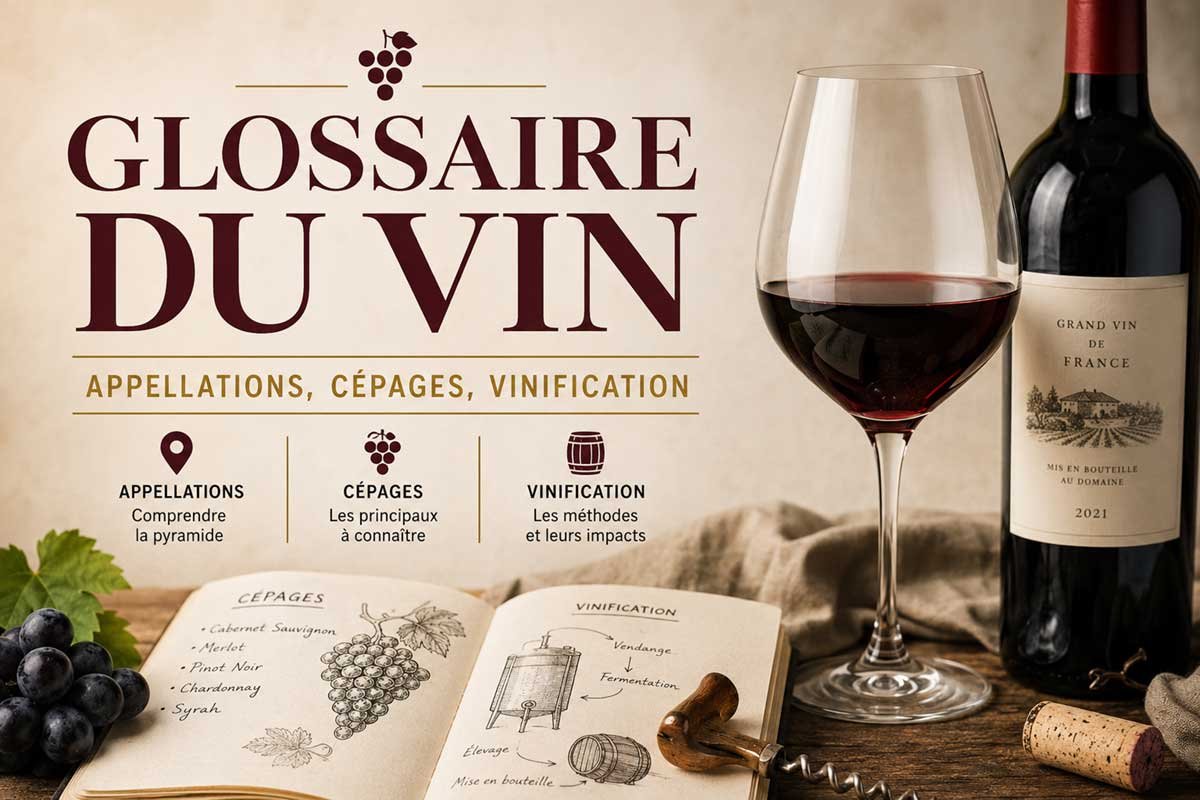
Wine has its vocabulary. Rich, sometimes obscure, often intimidating. And yet, behind the hundreds of terms in circulation, twenty or so are enough to grasp the essentials. Not every wine. Not every region. But enough to read a label, talk to a wine merchant, and avoid being taken for a ride in a restaurant.
This glossary covers three axes. The appellations first, because they structure the whole of French production. The grape varieties next, because they are the raw material and the names come up everywhere. The vinification at the end, because it explains why two wines from the same grape can be radically different.
Added to this are the alternative methods (organic, biodynamie, vin nature, vin orange) and the tasting vocabulary. Not to shine in company. To put words on what is in the glass. The aim is practical. Not encyclopaedic. If a term is missing here, it is because it is not essential for everyday drinking. Advanced enthusiasts will find more thorough works elsewhere. For the rest of us, what follows should answer eighty per cent of common questions.
Appellations: understanding the pyramid
France has structured its wine production as a pyramid. The higher you go, the stricter the specification. The lower you go, the freer the winegrower. Neither is better by nature. They follow different logics.
AOC and AOP: difference and history
The AOC (Appellation d'Origine Contrôlée) was born in 1935 with the creation of the INAO. It protects a product tied to a terroir, a savoir-faire, a set of practices. The AOP (Appellation d'Origine Protégée) is its European equivalent, introduced in 2009. The two appear on labels. In practice, they are the same thing. AOC for France, AOP for Europe. Note that the AOC applies to many products beyond wine. Roquefort was the first cheese to receive AOC status, as early as 1925. A little-known fact.
IGP: less strict, more flexible
The IGP (Indication Géographique Protégée) covers a wider area and imposes a less restrictive specification. The permitted yields are higher. So is the choice of grape varieties. Many southern wines (Pays d'Oc, Méditerranée, Côtes de Gascogne) sit in IGP. It is not a lesser wine. It is a framework that gives the winegrower more room to experiment, to plant international grape varieties, to step outside local conventions. Some talented producers choose IGP on conviction. Not by default.
Vin de France: no appellation
The category Vin de France is the freest. No geographic constraint. No grape variety obligation. Vintage and grape variety may be mentioned. This category covers anonymous industrial wine... and also free-minded winegrowers who reject the rules of their appellation. Reading "Vin de France" on a label says nothing about quality. You need to know the estate. Pierre Overnoy in the Jura, for example, long produced as Vin de France by choice.
Sub-classifications (premier cru, grand cru, village, etc.)
Within the AOCs, internal hierarchies exist. In Bourgogne: Régionale, Village, Premier Cru, Grand Cru. In Bordeaux, the 1855 classification (Médoc and Sauternes), the Saint-Émilion classification (revised regularly), and the Crus Bourgeois. In Champagne, Grand Cru and Premier Cru apply at village level. These hierarchies are not equivalent from region to region. A Burgundy Grand Cru designates a precise climat. A Bordeaux Grand Cru, a château listed in a historical ranking.
Why an appellation is not an absolute guarantee of quality
An AOC guarantees rules. Not talent. Within the same appellation you find excellent winegrowers and very ordinary ones. The specification sets a minimum threshold. It raises no one above it. Conversely, a Vin de France can be remarkable. The pyramid gives a framework. It does not write quality into the bottle. The name of the winegrower counts as much as the name of the appellation. Sometimes more.
Grape varieties: the main ones to know
A cépage, or grape variety, is a vine cultivar. The grape produced varies in size, skin, sugar, acidity and aroma. France officially counts more than 200 authorised grape varieties. A dozen are enough to make sense of what is drunk day to day.
Cabernet Sauvignon: Bordeaux and beyond
King of the Médoc, on the left bank of Bordeaux. Small berry, thick skin, powerful tannins. Produces wines built for ageing, structured, dominated by blackcurrant, cedar and graphite as they age. Very widely planted around the world (Napa Valley, Tuscany, Chile). In France, it rarely makes a wine on its own. It is almost always blended with Merlot, Cabernet Franc, sometimes Petit Verdot. It asks for patience. A five-year-old Cabernet Sauvignon is still young.
Merlot: supple, fleshy
The most planted grape variety in France. Dominates the right bank of Bordeaux (Pomerol, Saint-Émilion). Earlier than Cabernet Sauvignon, rounder on the palate, less tannic. Aromas of plum, dark fruit, cocoa with time. Produces wines that are approachable when young but can age for decades (Petrus, Cheval Blanc). At entry level, Merlot makes easy, sometimes flat wines. At the top of the pyramid, it reaches heights.
Pinot Noir: Bourgogne, Alsace, Champagne
A demanding, fragile, fickle grape variety. Small berry, thin skin, little colour, few tannins. But an aromatic finesse hard to match. Cherry, raspberry, undergrowth, mushroom as it ages. King of Bourgogne (Romanée-Conti, Chambertin). Widely planted in Alsace for light red. Pillar of Champagne in blends. Often attempted elsewhere, rarely successful with the same brilliance. It calls for a cool climate and a precise terroir.
Syrah: Côtes du Rhône
The flagship grape variety of the northern Rhône (Côte-Rôtie, Hermitage, Cornas). Dense colour, characteristic peppery scent, notes of violet, blackberry, smoked bacon. Firm but silky tannins. Can age twenty years or more in the great crus. Also present in the south, blended with Grenache and Mourvèdre. Outside France it is called Shiraz in Australia, where it gives more powerful, more solar wines.
Grenache: south, Mediterranean blends
A southern grape variety, a high yielder, rich in sugar and therefore in alcohol. Produces rounded, generous wines with notes of candied red fruit, garrigue, and warm spice. Pillar of Châteauneuf-du-Pape, Gigondas, Vacqueyras. Also present in the Languedoc and Roussillon, where it is used for vins doux naturels (Banyuls, Maury, Rivesaltes). Vinified into rosé in Provence. Often blended with Syrah and Mourvèdre in the famous "GSM".
Gamay: Beaujolais
The near-exclusive grape variety of Beaujolais. Produces fruity, easygoing wines, low in tannin. Notes of strawberry, banana (typical of Beaujolais Nouveau, linked to carbonic maceration), spices. Long looked down on, it is making a comeback through the ten Beaujolais crus (Morgon, Fleurie, Moulin-à-Vent, etc.). These crus produce wines capable of ageing a decade. Far from the Beaujolais Nouveau clichés.
Chardonnay: Bourgogne and Champagne
The best-known white grape in the world. A chameleon: it takes on the colour of its terroir and its élevage. Fresh and mineral at Chablis. Rich and buttery in Côte de Beaune. Crisp and straight in Champagne (Blanc de Blancs). Takes oak better than most white grapes. Produces wines for ageing when it comes from a good terroir. Without terroir and without care, it also produces anonymous whites that are widely planted around the world.
Sauvignon Blanc: Loire and South-West
A crisp, aromatic grape variety, recognisable on the first sniff. Grapefruit, boxwood, blackcurrant bud, sometimes gun flint. Pillar of Sancerre and Pouilly-Fumé in the Loire. Also present in the south-west (Bergerac, white Bordeaux, where it blends with Sémillon). At Sauternes, it contributes to the great sweet wines. It needs cool temperatures to keep its nerve. Vinified dry in 95% of cases. Serve cool.
Chenin Blanc: Loire
The chameleon grape of the Loire (Anjou, Touraine, Vouvray, Saumur). It can do everything: dry, off-dry, medium-sweet, sweet, sparkling. Its high acidity gives it an exceptional capacity for ageing. A Vouvray or a Savennières can age fifty years. Aromas of quince, honey, white blossom, apple, straw. Often underrated in France. Highly prized by serious enthusiasts. One of the best whites for the table.
Riesling: Alsace
King of the Alsace grape varieties. Very aromatic but dry and taut (unlike its often medium-sweet German cousin). Notes of citrus, white flowers, minerals, and the petrol note with age (an aroma sought by enthusiasts, surprising for beginners). Remarkable capacity for ageing. The Alsace Grands Crus can age twenty years. Perfect with fish, seafood, Asian food. A grape that takes time to understand, but once you have, you do not forget.
Indigenous grape varieties enjoying a revival (Carignan, Cinsault, Mondeuse, etc.)
Long out of fashion, some grape varieties are coming back. Carignan, everywhere in the Languedoc, gives powerful, fresh wines from old vines. Cinsault produces light reds and delicate rosés. Mondeuse in Savoie offers spiced, taut reds. Trousseau and Poulsard in the Jura, Négrette in Fronton, Mauzac in Gaillac, Petit Manseng in the south-west. This diversity makes the richness of the French vineyard. (Re)discovering it is a pleasure.
Vinification: how the wine is made
The grape does not become wine by magic. Each step shapes the final profile. Knowing the broad lines helps in reading a label, in asking a winegrower the right questions, in explaining why two Pinot Noirs from the same parcel can taste different.
Manual versus mechanical harvest
Manual vendanges allow sorting in the vineyard, respect for whole bunches, access to steep parcels. They are more expensive. Mandatory for certain AOCs (Champagne, Beaujolais, some Burgundy crus, Banyuls). Mechanical harvest is quick, less costly, but picks up ripe and less ripe berries together. For great wines, manual remains the rule. For bulk wine, machines dominate. It is not an absolute mark of quality, but it is a signal.
Red, white and rosé vinification
For red, the juice ferments with the skins. The maceration extracts colour, tannins, aromas. Destemming (separating the berries from the stems) is now common but not systematic. Final pressing recovers the press wine, which is more tannic. For white, pressing is immediate, without maceration. For rosé, two methods: saignée (drawing off juice after a few hours of maceration) or direct pressing (the dominant method in Provence, which gives the very pale rosés).
Élevage: stainless steel, new oak, used oak, amphora
Élevage is the period between the end of fermentation and bottling. Stainless steel preserves the fruit, with no input from wood. New oak (generally French) brings vanilla, toasted, even smoky notes. Marked in the first years, it fades later. Used oak (after two or three previous fills) brings slow oxygenation without the woody taste. Amphora (earthenware, stoneware, sometimes wax-lined) is making a return, especially in the south and among vin nature producers. It gives pure fruit, a silky texture.
Malolactic: when it happens, what it brings
The malolactique fermentation (or "malo") converts malic acid (sharp acidity, like green apple) into lactic acid (gentler acidity, like yoghurt). It softens the wine, gives it weight, lactic notes, sometimes buttery ones in whites. Almost systematic in red. Chosen or refused in white according to the style sought. A Chablis without malo will keep its tension. A Meursault with malo will have that characteristic richness. The winegrower decides.
Sulphite addition: why, at what doses, wines without added sulphites
Sulphur (SO2) is a preservative added in the vineyard and in the cellar. It protects against oxidation and bacterial faults. Without it, few wines would travel. Legal doses are regulated: maximum 150 mg/l in red, 200 mg/l in white, 400 mg/l in sweet wines. Organic lowers them. Wines "without added sulphites" exist but are fragile: keep them cool, drink them young, and accept that they can be unpredictable. All wines contain residual natural sulphur produced during fermentation.
Bottling: when, why wait
Bottling marks the end of élevage. It usually follows filtration (sometimes not, in vins natures, which stay hazy). Some wines are bottled quickly to preserve the fruit (Beaujolais, crisp whites). Others wait eighteen months, two years, sometimes more (great reds built for ageing). After bottling, the wine goes through a "shock" period when it closes up. Then it gradually opens again. Opening a bottle three months after bottling is rarely a good idea.
Alternative methods to recognise
Over the past thirty years, alternative approaches have settled into the landscape. They are not all equivalent. They are not all governed in the same way. Here are the main ones.
Organic wine (specification)
Organic wine has been governed by a European regulation since 2012 (the AB label has existed since 1980 for other products). In the vineyard: no synthetic chemicals; treatments limited to copper and sulphur. In the cellar: limited oenological additives, lower SO2 doses. Conversion takes three years. The label guarantees compliance with the specification, verified by a certifying body. It says nothing about style or final quality.
Biodynamic wine (Demeter, Biodyvin)
The biodynamie draws on the work of Rudolf Steiner (1924). It treats the vineyard as a living organism. Plant-based preparations, lunar and planetary calendar, refusal of chemical inputs. Two main certifications: Demeter (created in 1928, the oldest) and Biodyvin (1995, specific to wine). More demanding than organic. A controversial approach scientifically, but with results praised in the bottle by many tasters. In the vineyard, the soils are often visibly alive.
Vin nature (no strict official French definition)
Vin nature (or natural wine) aims to minimise intervention: manual vendanges, indigenous yeasts, no or very few additives, minimal or zero sulphite addition. In France, there is as yet no AOC or state label. A private label has existed since 2020 (Vin Méthode Nature). Many vins natures are remarkable. Others suffer from defects (volatile acidity, brett, oxidation). The movement is young. Try, form your own view. Do not confuse with organic or biodynamie.
Vin orange: white wine with maceration
Vin orange is a white wine vinified like a red: the skins stay in contact with the juice for days, sometimes months. This extracts colour (from amber yellow to copper orange), light tannins, complex aromas (dried fruit, spices, candied citrus). A very old tradition (Georgia, Slovenia, Italy). In France it is increasingly seen, especially among vin nature producers. A table wine, served slightly cool, with bold dishes.
Pet'nat: ancestral method
Pétillant naturel ("pet'nat") is made by the ancestral method: the wine is bottled before fermentation has finished, with no liqueur de tirage added. The gas comes from the natural residual sugar. No riddling, no compulsory disgorging. A crown cap, sometimes a visible deposit. Fresh taste, low in alcohol, sometimes slightly cloudy. A tradition retrieved from Limoux (the ancestral blanquette has existed since the sixteenth century), today produced everywhere. An ideal apéritif.
Tasting vocabulary: the essentials
No need for a 500-word lexicon. A few notions are enough to talk about a wine without stumbling.
Appearance (colour, intensity)
The appearance is the visual aspect of the wine, what the French call the robe. You look at the colour (purple, ruby, garnet, tawny for reds; pale gold, golden, amber for whites). The intensity shows the concentration. A light red lets the light through, a dense red looks opaque. The colour evolves with age: reds lighten and brown, whites turn yellower. A white that is too amber may be oxidised. A red that is too tawny may be past its best. A first clue.
Nose (first nose, second nose, primary/secondary/tertiary aromas)
The nose is the smell of the wine. You distinguish the first nose (glass still) from the second nose (after aeration by swirling the glass). Primary aromas come from the grape (fruit, flowers). Secondary aromas from fermentation (brioche, lactic). Tertiary aromas from élevage and ageing (undergrowth, leather, tobacco, truffle). A young wine smells of fruit. An evolved wine smells of something else. Neither better nor worse. Different.
Palate (attack, mid-palate, finish)
The tasting on the palate breaks down into three stages. The attack (the first seconds, the first impression). The mid-palate (the development, the texture, the structure). The finish (the persistence of the aromas after swallowing or spitting). The French speak of caudalies to measure length (one caudalie equals one second). A short finish (3-4 caudalies) marks an average wine. A long finish (above 8) signals a great wine. The longer the finish, the more complex the wine.
Tannins (supple, firm, angular)
Tannins come from the skins, the pips, the stems, sometimes from the oak of the élevage. They give a red wine its structure, its astringency (that drying sensation on the tongue). They are described as supple (easy, integrated), firm (present but well-knit), angular (rough, unpolished, the mark of a young or badly made wine). A great young red has powerful but silky tannins. Over time, the tannins soften. The wine settles.
Balance of acidity, sugar and alcohol
A balanced wine plays on three axes: acidity (which gives freshness), sugar (residual or perceived through the fruit), alcohol (which brings warmth and roundness). A wine that is too alcoholic without acidity feels heavy. A wine that is too acidic without sugar or alcohol feels lean. A medium-sweet white with no acidity is cloying. Balance is subjective but recognisable. When you drink a wine and nothing feels jarring, it is in balance. Quite simply.
Frequently asked questions
How do I choose a wine without knowing the appellation?
Look at the grape variety, the region and the vintage. A 2020 Burgundy Pinot Noir will tell you more than an obscure appellation name. Asking the wine merchant remains the best method. Mention the meal, the budget, the profile you want (supple, tannic, fruity).
Do you always need to decant a red wine?
No. A young, tannic wine benefits from aeration, sometimes decanting an hour beforehand. An older wine is fragile. Open it simply, wait ten minutes, taste. Decanting an old Bordeaux can speed up its oxidation and break the aromas.
How long can you keep an opened wine?
Two to three days for a still wine, recorked and kept cool. A fortified sweet wine holds for several weeks. A sparkling wine loses its bubbles within hours, even sealed. Vacuum pump stoppers help a little.
Are sulphites dangerous?
At legal doses, no. The mention "contains sulphites" is mandatory above 10 mg/l. Some people are sensitive and get headaches. Wines without added sulphites exist but should be drunk young and kept cool.
Is organic wine necessarily better?
Not necessarily. The organic label guarantees the absence of synthetic chemicals in the vineyard and limits certain additives in the cellar. It says nothing about the winegrower's talent. A good conventional wine can beat a poor organic wine. Certification does not replace the palate.
How do I read a label in 30 seconds?
Five pieces of information matter. The name of the estate. The appellation (AOC, IGP, Vin de France). The vintage. The grape variety if mentioned. The name of the winegrower or the cooperative. The rest (medals, marketing copy) is secondary.
To go further
This glossary sets the frame. The rest is built in the glass. Tasting, comparing, taking notes, holding on to one grape variety at a time. Talking to the winegrowers is probably the best school. They explain their choices, their hesitations, their successes. One cellar visit is worth ten books.
On Épicurieux, the winegrower listings cover the whole of France: the Château de Rey in Roussillon, the Domaine du Vallon des Glauges in Provence, Calmel & Joseph in the Aude, Gilles Noblet in Pouilly-Fuissé, the Domaine du Serre des Vignes in Grignan-les-Adhémar (organic), the Champagne Meteyer in the Marne valley. Different appellations, different methods, the same demand for work well done.
To explore the full selection, see the Winemakers category or filter the interactive map by keyword. Good tasting.