Home › The journal › Did you know? Short histories of French terroir
Did you know? Short histories of French terroir products
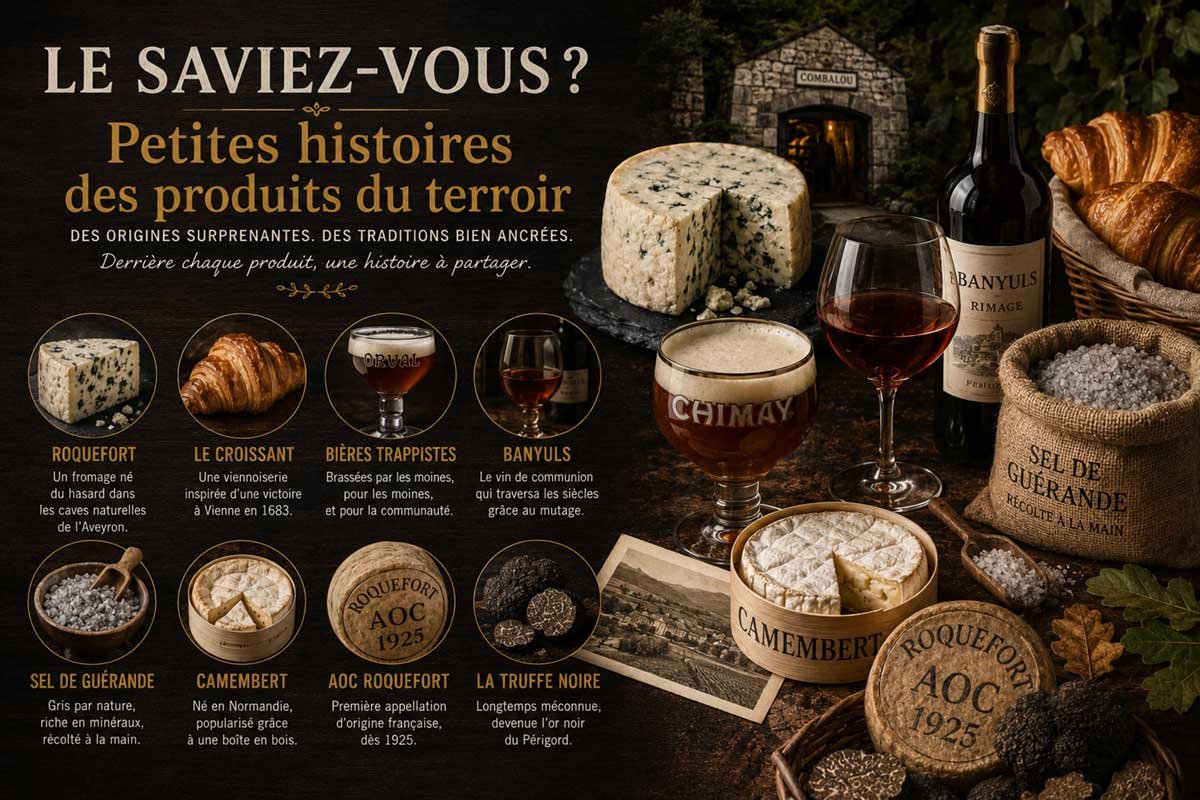
Behind every French terroir product sits a story. Sometimes ordinary, sometimes wild, often centuries old. Why is Roquefort blue? Where does the croissant come from? Why is Guérande salt grey? These accounts explain what we eat and drink. They lend texture to the taste. They remind us that the great French specialities did not fall from the sky. They are the product of a place, a climate, a happy accident, and sometimes a long patience. This column starts a regular series. Here, to begin, are eight short and verifiable stories to share at the counter or at the table.
Why Roquefort is blue
Roquefort owes its blue-green veining to a microscopic fungus: Penicillium roqueforti. It grows naturally in the limestone caves of the Combalou, above Roquefort-sur-Soulzon, in the Aveyron. Legend has it that a lovestruck shepherd left his lunch of bread and cheese in a cave and found it blued over weeks later. More prosaically, it is the cold, damp air currents moving through the natural fleurines of the Combalou that let Penicillium flourish there over the centuries. The fungus is now cultivated in the laboratory, but the ageing still happens in the natural cellars of the village.
The origin of the croissant: Vienna, 1683
The croissant is not French in origin. Its shape recalls the siege of Vienna in 1683, when the Ottomans were laying siege to the city. The tradition holds that Viennese bakers, working in the early hours, heard the Turks digging tunnels under the ramparts and raised the alarm. To celebrate the victory, they reportedly created a crescent-shaped pastry, the Ottoman emblem. The recipe is said to have reached Paris in 1838 with August Zang, an Austrian officer turned baker on the rue de Richelieu. His Viennese bakery inspired a whole generation of French bakers, who adapted the dough to French taste: laminated, leavened, made with butter.
Why some beers are called "Trappist"
The term "Trappist" is tightly defined. A beer can only carry it if it is brewed inside a Trappist abbey, under the supervision of the monks, and if proceeds go back to the monastic community or to charity. Only eleven breweries today are authorised to carry the "Authentic Trappist Product" mark. Six are in Belgium (Chimay, Orval, Rochefort, Westmalle, Westvleteren, Achel) and just one in France: the abbey of Mont des Cats, in the Flanders region. The other "abbey beers" are made by industrial brewers under licence, with no monastic presence on site.
Banyuls as communion wine
Banyuls, the fortified wine of the Roussillon, was for a long time the favoured altar wine of the French clergy. Its high residual sugar and an alcohol level around 16 per cent meant it kept well in the vestry without turning. Mutage with grape spirit, devised in the 13th century by Arnaud de Villeneuve, a Catalan physician and alchemist, secured its stability. For centuries Banyuls accompanied the Eucharist across southern France. Today it is mostly appreciated alongside dark chocolate and fruit puddings, but its liturgical past remains written into its history.
Why Guérande salt is grey
Guérande salt is grey because it is not refined. Hand-harvested in the salt marshes of the Guérande peninsula, in Loire-Atlantique, it is raked up onto the banks with a lousse, then dried by sun and wind. Its grey colour comes from the fine clay particles at the bottom of the œillets, where the salt worker scrapes it up. That clay also brings some of its minerals: magnesium, potassium, calcium. Fleur de sel, gathered from the surface of the œillets on dry, windy days, is whiter and rarer. Grey salt remains the everyday salt of the kitchen, while fleur de sel is used for finishing.
Where the name "Camembert" comes from
Camembert takes its name from the village of Camembert, in the Orne, in Normandy. Tradition credits the recipe to Marie Harel, a farmer's wife at Camembert, who is said to have refined production around 1791 with advice from a refractory priest from the Brie, hidden on her farm during the Revolution. The tale is partly legend, but the archives confirm that Marie Harel did exist and helped spread the cheese. Camembert took off in the 19th century, with the Paris-Caen railway and the invention of the round wooden box by Eugène Ridel and Georges Leroy in 1890, which finally allowed it to travel without breaking.
How Roquefort obtained the first French AOC
Roquefort is the first French cheese to have been granted an appellation d'origine, by the law of 26 July 1925. But its protection goes back much further. As early as 1411, Charles VI granted the inhabitants of Roquefort-sur-Soulzon a monopoly on ageing in the Combalou caves, by letters patent. That was the first legal recognition of a cheese terroir in Europe. In 1925, France formalised the principle with the law on appellation d'origine. Roquefort would be followed by other cheeses, wines and spirits. The French AOC system would later inspire the European AOP and equivalent regimes around the world.
The Périgord noir and the black truffle, Tuber melanosporum
The black Périgord truffle, Tuber melanosporum, was not always the luxury we know. In the Middle Ages people distrusted it. It was the Renaissance that brought it into court cooking. But it was the 19th century that saw its peak: France was then producing more than 1,000 tonnes a year. Phylloxera devastated the vineyards of the Sud-Ouest, and farmers replanted truffle oaks in their place. The harvest exploded. Two world wars, rural depopulation and the abandonment of the truffières dropped production to under 50 tonnes a year today. The markets of Lalbenque, Sarlat and Richerenches remain the high places of this discreet trade.
A recurring column
These stories will come back. Once a month, a new run will follow. Why is Dijon mustard often made with Canadian seeds? Where does Cognac come from? Why does the Agen prune originally come from Damascus? How did Maroilles take hold in the North? Why is Armagnac older than Cognac? French terroir holds enough anecdote for years of writing. For more today, browse our selections of places, sorted by things to taste, by independent winemakers, or follow the map to find good houses near you.
Frequently asked questions
Are these terroir stories true?
We consistently separate documented fact from popular legend. Many terroir products have a reliable, dated, sourced history: Roquefort's first AOC in 1925, the founding of the Isigny dairy, the decree drawing the Champagne boundary. Others are stories tradition has carried forward without formal proof. When that is the case, we say so.
Why do terroir stories matter?
Because they give meaning to what we eat and drink. A product is not only a flavour. It is also a place, a climate, a technique, generations of repeated gestures. Knowing where Banyuls comes from, or why Guérande salt is grey, changes the way you taste them. And supports the producers who keep these skills alive.
How do you check these stories?
We cross-check sources: histories of food, AOP/AOC/IGP specifications, departmental archives, producer monographs, the sites of professional bodies. When a story rests on oral tradition without documentary confirmation, we present it as such.
Will these stories come back?
Yes. This is a recurring column. We publish a new run of short histories once a month. To keep up, browse the Épicurieux journal regularly or look through our selections of places in the charcuterie, cheesemaker and winemaker categories.
Knowing the small history of a product does not make it a better product. But it does help us choose it better, defend it better, pass it on better. That is also the work of Épicurieux: pointing to good houses and recounting what stands behind them.