Home › The journal › French food labels decoded: AOP, IGP, Label Rouge, STG, Bio
French food labels decoded: AOP, IGP, Label Rouge, STG, Bio
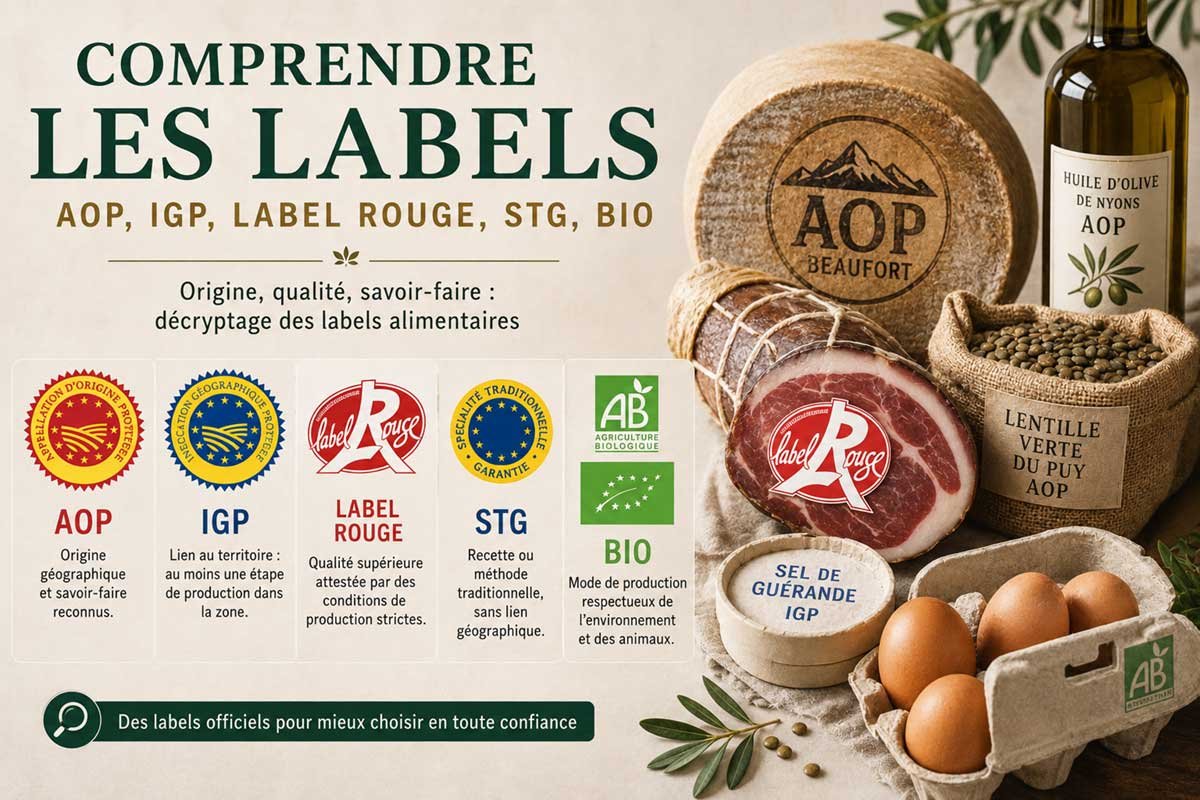
French food packaging is covered in logos. AOP, IGP, Label Rouge, STG, AB, Eurofeuille, plus the private retailer marks that imitate the official graphic codes. Most shoppers cannot tell them apart, and for some that is the point. Yet each label covers a precise reality (geographic origin, traditional method, superior quality, production system) and each has limits worth knowing. This decoder runs through the five official labels: what they really guarantee, what they do not, and how to tell them apart from the private marks invented by the supermarkets.
AOP: Appellation d'Origine Protégée
This is the most demanding of the labels. AOP guarantees that a product is made entirely within a defined geographic area, with recognised know-how, and from raw materials sourced from that same area. Every stage (production of the raw material, transformation, finishing) must take place in the defined territory. The specification is strict and lists animal breeds, permitted feed, production techniques, ageing times, storage conditions.
The French cheese AOPs are the best known: Roquefort (the oldest, recognised in 1925), Comté, Beaufort, Reblochon, Bleu d'Auvergne, Cantal, Salers, Munster, Brie de Meaux, raw-milk Camembert de Normandie. On the charcuterie side, Noir de Bigorre, Kintoa du Pays Basque, Porc du Sud-Ouest. On oils, Nyons, the Vallée des Baux, Nice. On vegetables, the green lentils of Le Puy, pink garlic of Lautrec, walnuts of Grenoble, chestnuts of Ardèche. On wines, almost every French appellation is AOP.
What AOP does not guarantee: absolute quality on the palate. A raw-milk AOP Camembert from a small producer has nothing in common with an industrial AOP Camembert from the big cooperatives, yet both are entitled to the logo. AOP guarantees origin and adherence to the specification. The rest is down to the producer.
IGP: Indication Géographique Protégée
IGP is less strict than AOP. At least one stage (production, transformation or finishing) must take place inside the defined area, but not all of them. The tie to the terroir is therefore looser. It is a useful label for products that have a history in a region without the whole chain necessarily sitting there.
Well-known French examples: Jambon de Bayonne IGP (the pigs come from several regions of the Sud-Ouest, only the curing happens in the Adour basin), Sel de Guérande IGP, Agneau du Quercy, Poulet du Gers, Pruneau d'Agen, Volailles de Bresse (which also have AOP for the strict version), Bœuf Charolais du Bourbonnais, Lentilles du Berry, Riz de Camargue, Cidre de Bretagne.
The classic Bayonne case illustrates the limit well. An industrial Bayonne IGP can be made from pigs reared in Brittany or Spain, slaughtered in the Vendée, and cured only in the Adour. Legally it is entitled to the name. A shopper might reasonably expect more. Always check who reared the pig, not just who cured it.
Label Rouge: superior quality, not origin
Created in 1960, Label Rouge is a French invention. It says nothing about geographic origin but guarantees a level of taste quality above the market average. The specification sets production conditions (breed, feed, rearing time, slaughter conditions) more demanding than the norm, and products undergo regular organoleptic testing.
The classic examples are poultry (Poulet de Bresse, Poulet fermier des Landes, Poulet d'Auvergne), meats (farm veal raised with its mother, Bœuf Limousin, Label Rouge lamb), free-range eggs, smoked salmon under Label Rouge (notably "Écosse Label Rouge", which imposes a stricter Scottish standard than average), Guérande salt, Charentes-Poitou butter, fir honey from the Vosges.
What Label Rouge does not say: where the product was reared or made. A "Label Rouge Écosse" salmon may be smoked in Poland and sold in France. A Label Rouge chicken can come from anywhere in France. The label guarantees production standards, not terroir.
STG: Spécialité Traditionnelle Garantie
STG is the rarest of the European labels. It protects a traditional recipe or a particular composition, without reference to a geographic area. Anyone can make an STG product if they follow the specification. It is therefore a label of method, not of origin.
In France, STGs are few. The moule de bouchot (the mussel grown on wooden stakes) is the only genuine French speciality recognised STG. At European level there is STG Mozzarella (a recipe, not an origin, which distinguishes it from Mozzarella di Bufala Campana, which is AOP), STG Neapolitan pizza, STG Serrano ham. The label stays niche and is rarely seen in supermarkets.
Bio: French AB and European Eurofeuille
The AB label (Agriculture Biologique) is a French label created in 1985. Since 2010 it has been aligned with the European regulation and sits alongside the Eurofeuille logo (the green starred leaf), which is compulsory on every organic product sold in the European Union. Both logos guarantee the same things: no synthetic pesticides, no GMOs, no chemical fertilisers, severe restriction of additives (around fifty allowed, against three hundred and fifty in conventional production), improved rearing conditions (access to the outdoors, organic feed, lower stocking densities).
Inspections happen at least once a year by certified bodies (Ecocert, Bureau Veritas, Certipaq, Qualisud, Bureau Alpes Contrôles). Organic is therefore a reliable label on the method of production. It has two blind spots though. First, organic does not guarantee taste. An industrial Spanish organic tomato is still a tomato grown hydroponically under a heated glasshouse. Second, organic does not guarantee local origin. The minimum rule is that origin must be stated ("origin EU", "origin non-EU", "origin France") but it goes no further.
Several stricter organic labels exist alongside (Demeter for biodynamic farming, Nature et Progrès, Bio Cohérence) with tougher specifications on processing, origin and ethics. They are private but considerably more demanding than the European baseline.
Private labels: avoiding the confusion
Filière Qualité Carrefour, Saveurs en'Or, Engagement Qualité Auchan, Reflets de France, Nos Régions Ont du Talent, U Saveurs, Mmm! Auchan, le Tour de France des Saveurs. These retailer brands are not official labels. They are private specifications, checked by the chain itself or by bodies it pays directly.
They are not automatically bad. Filière Qualité Carrefour, for instance, applies criteria close to Label Rouge for some products (breed, rearing time, GMO-free feed). But the inspection is internal, the consequences for breach are commercial, and the chain is judge and jury. These labels mostly do two jobs for the supermarkets: lock in a supply chain, and differentiate the offer without paying the premium of a real official label.
The simple test is to look at who certifies. An official label cites a third-party body accredited by COFRAC. A private label cites the chain itself or a consultancy with no independent accreditation. The distinction is legal but it counts.
What actually matters at the point of purchase
An official label is a minimum guarantee, not a blank cheque. Three practical questions help. First, who made it? A named farm, dairy or estate is worth more than a generic brand. Second, where exactly? "Aveyron" or "Aubrac" is more useful than "France". Third, how? Breed, feed, rearing time or ageing time appear in the real specifications of AOP and Label Rouge products. If that information is missing from the back of the pack, the producer has nothing to put forward.
One last rule applies to every label. None of them replaces tasting and a direct relationship with the producer. The genuinely good places are almost always AOP or IGP, but the reverse is not true. An industrial AOP Camembert will be less interesting than a well-made farm cheese with no label. Labels are there to eliminate the worst, not to reveal the best.
Frequently asked questions
What is the difference between AOP and AOC?
AOC (Appellation d'Origine Contrôlée) is the historic French label, created in 1935 for wines. AOP (Appellation d'Origine Protégée) is the European version, created in 1992 to harmonise geographic protections. Since 2009, French food products carry only the AOP mark. Wines may still display AOC in France, but it is AOP that counts for export. The specification behind both is the same.
Is organic produce really organic?
Yes, in the sense that European regulation 2018/848 bans synthetic pesticides, GMOs and chemical fertilisers, and drastically restricts additives. But organic certifies the production method, not taste, not local origin, not social conditions. An industrial Spanish organic tomato and a small Ardèche organic farm carry the same Eurofeuille logo. Reading the specification and the origin still matters.
Can you trust supermarket private labels?
Only up to a point. Private labels such as Filière Qualité Carrefour, Saveurs en'Or, Engagement Qualité Auchan and Reflets de France are internal specifications checked by the chain itself or by bodies it pays. They can impose real criteria (breed, feed, rearing time) but they do not match an independent official label. They mostly serve marketing and internal traceability.
Who actually controls the official labels?
In France, INAO (Institut National de l'Origine et de la Qualité) supervises AOP, IGP, Label Rouge, STG and AB. Field inspections are delegated to independent certifying bodies accredited by COFRAC (Bureau Veritas, Certipaq, Qualisud, Ecocert, Bureau Alpes Contrôles and others). Every operation is inspected at least once a year, sometimes more, with documentary audits and physical sampling.
The categories where these labels count most appear on Épicurieux in the Charcuterie and meat, Winemakers, Farm produce, Seafood and Chocolate and confectionery selections. Know a producer under an official label worth recommending? The contact page is open.