Home › The journal › Good food places in Occitanie
Good food places in Occitanie
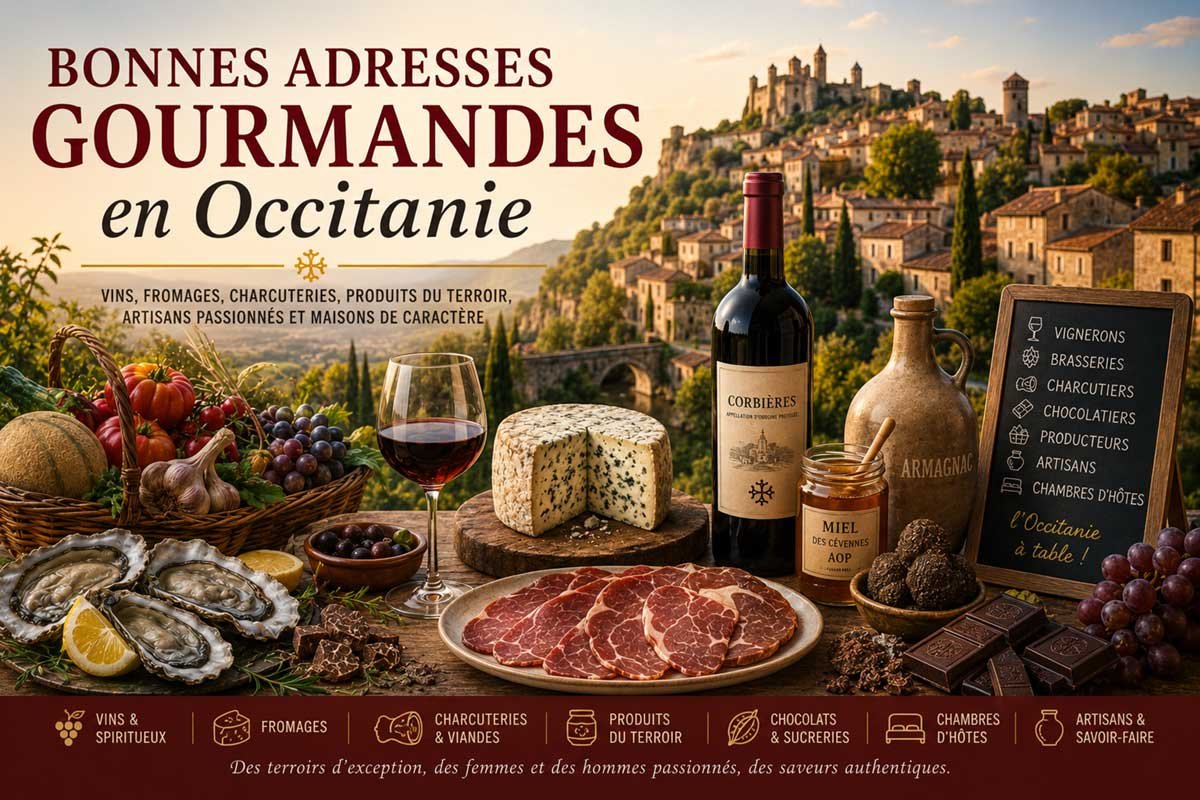
Occitanie is arguably the most complete region of France at the table. Thirteen départements, two coastlines, three mountain ranges. The Mediterranean on one side, the Pyrénées on the other, the Massif Central to the north, and in between the Causses, the Lauragais, the Languedoc plain, and the hillsides of the Tarn, the Lot and the Gers. Each sub-region has its own cooking, its own grape, its own livestock, its own sweet. That density is what we look at here, through a selection of Épicurieux listings, all logged and visited.
The region's food identity
Occitanie's table is born of its geology as much as its history. In the south, the burning schists of the Albères and Banyuls give concentrated grenaches. Further west, the limestones of the Corbières and the Minervois carry carignan, syrah and mourvèdre. The Lauragais, once a wheat country, today supports mixed cereal farming and black-pig rearing. To the north, the dry, windswept Causses of the Quercy and the Aveyron have held the Lacaune sheep for centuries, which yield Roquefort and pérail. The climate follows the same logic. Mediterranean on the coastal strip, oceanic-leaning to the west, alpine above a thousand metres in the Lozère and the Aubrac. That spread is why an Occitanie table can put out, in one sitting, oysters from Leucate, a Pyrenean sheep's cheese, a duck breast from the Gers and a chocolate dessert from Mazamet.
Historically, this is a land of plenty in the strict sense. Woad farming made the Lauragais wealthy in the 16th century. Salt from Aigues-Mortes, the olive from the Hérault valley, the Cévennes chestnut, the honey of the Causses, and the truffles of the Lot and the Quercy have built small farming economies that still survive. The region also saw the birth of Armagnac, France's oldest spirit, distilled in the Gers since the 14th century.
The signature products
On wine, Languedoc-Roussillon remains the largest wine region in the world by surface area. AOC Languedoc, Corbières, Minervois, Faugères, Saint-Chinian, Pic Saint-Loup, Limoux for the sparkling, Cahors for malbec, Gaillac for its forgotten grapes such as mauzac and braucol, Côtes du Roussillon and Côtes du Roussillon Villages, plus the fortified wines of Banyuls, Maury, Rivesaltes and Muscat de Frontignan. On charcuterie, the Gascon black pig, jambon d'Aveyron, the dried sausages of Lacaune and the Pyrenean garbure are the headline acts. On cheese, Roquefort, pélardon, rocamadour, bleu des Causses, laguiole, tomme des Pyrénées and bethmale would draw a map of France on their own.
The sea brings its share. The oysters of the étang de Thau, those of Leucate, the mussels of Bouzigues, the tielle of Sète, the bourride and the cuttlefish rouille. On sweet, the calisson is not from here but the Gascon croustade is, along with millas, prune rissoles, and the jeannots of Pézenas. Cévennes chestnut, Lozère honey, gariguette and ciflorette strawberries from the neighbouring Lot-et-Garonne, Tarn apples, the melon of Lectoure, the black truffle of the Quercy round out the inventory. Each product feeds a festival, a market, a family recipe.
Seasons and markets to know
The Occitan calendar is dense. January to March, the black truffle is at its height on the markets of Lalbenque and Limogne-en-Quercy. April and May, the first gariguette strawberries and the asparagus of the sandy coast. June, Roussillon cherries. July and August, Roussillon apricots, Lectoure melons, field tomatoes and the first table grapes. September to October, harvest everywhere, chestnuts in the Cévennes, ceps in the Aubrac. November, foie gras fairs in the Gers, the first white truffles of the Lot. December, Christmas markets and the height of the oyster season.
On markets, Uzès on a Saturday morning, Pézenas on a Saturday, Saint-Antonin-Noble-Val on a Sunday, the truffle market of Lalbenque on a Tuesday, the Capucins market in Béziers, the Marché Victor-Hugo in Toulouse on weekdays, and the market on the Place Cassanyes in Perpignan on a Sunday all remain essential stops for understanding the region at stall height.
Our Épicurieux finds
In the Languedoc, we often begin with wine. Near Montirat, in the Corbières, Calmel & Joseph turns out precise cuvées built on very low-yielding parcels. At Gardie, Domaine Garrabou defends the whites of Limoux and uncompromising vineyard work, a short hop from Clos Teisseire, at Rouffiac-d'Aude, which draws upright, sharply drawn reds from its stony soils. Further east on the coast, Château de Rey at Canet-en-Roussillon keeps a family wine estate going, focused on muscats and Côtes-du-Roussillon. At Noailles in the Tarn, Château Bouscaillous brings Gaillac and organic conversion into conversation on windswept slopes.
On the coast, Huîtres Allary at Leucate are a calibrated, precise benchmark, grown on the right shore of the lagoon. On spirits, Armagnac Goudoulin at Courrensan ages its eaux-de-vie by a family method handed down from the 19th century. On beer, Occitanie has a particularly active brewing scene. Brasserie Garland at Algans works organic and small-farm sourcing, Brasserie Ratz at Fontanes near Cahors makes recipes rooted in the Pays d'Olt, Brasserie d'Olt at Saint-Geniez-d'Olt carries the same gesture into the Aveyron, and Brasseurs de la Cité keep an urban brewery alive in Carcassonne, true to its base.
On charcuterie, two houses illustrate the region's two poles. Ferme de la Bracadelle at Labécède-Lauragais raises Gascon black pigs outdoors, and Charcuterie Suc at Paulinet, in the Tarn highlands, carries forward the cured meats of the Haut-Dadou. Still in farm territory, La Métairie Neuve at Saint-Paul-Cap-de-Joux raises Barbary ducks for foie gras by a slow method. On condiments, the garlic of Christian Bardou at Frèjeville, an organic farmer in the Tarn, is worth the detour on its own.
On sweet, Occitanie does not disappoint. At Mazamet, Guy Roux Chocolatier, the French champion of sugar-free chocolate, works with pure-origin couvertures. At the Abbaye de Bonneval, in the Aveyron, the Cistercian sisters of the Abbaye de Bonneval still make their bars and ganaches by a monastic method. At Sainte-Radegonde, also in the Aveyron, Sanhes is one of the few farm-based ice-cream makers in the south, from milk to cone. In Carcassonne, La Belle Aude draws whole-milk ice creams and full-fruit sorbets. And near Castres, Merit offers a raw, creamy honey that sums up on its own the floral wealth of the foothills of the Montagne Noire.
To stay and stretch the visit, Mas de Garrigue at Calvignac, in the Lot, remains one of the best-rated places in the region, and Alma at Collioure offers a bohemian base a few steps from the coves. For the curious, the raku ceramic studio of Jackie-Créa at Saint-Antonin-de-Lacalm is a reminder that Occitanie is also a country of craft artisans.
Going further
Occitanie reveals itself slowly. A four-day loop can link Carcassonne, the Corbières and Leucate. Another, Cahors, the Lot and the Aveyron. A third, the Gers, Armagnac country and the Pyrenean foothills. By category, our winemaker, craft beer, charcuterie and meat and chocolate and confectionery selections give another way in. To plan a weekend, the chambres d'hôtes section doubles as an address book.
Frequently asked questions
What is the best season to explore Occitanie at the table?
The late season, September to November, is the most complete. The harvest is in full swing, chestnuts and mushrooms arrive, and the oysters of Thau and Leucate return to full brininess after the summer.
Which Occitanie product remains most underrated?
The Gascon black pig. A rustic breed reared outdoors in the Gers and the Lauragais, its marbled flesh yields charcuterie of rare finesse, still little known outside the region.
Can you visit producers on site?
The great majority of wine estates, breweries, chocolatiers and farms in Occitanie welcome visitors or run direct sales. It is better to book outside high season, and to call ahead before turning up at family operations.
Where can you find Occitanie products outside the region?
Most of the producers listed run an online shop. Independent wine merchants, central-city épiceries fines and certain Paris markets such as Aligre or Batignolles regularly stock their cuvées and their cured meats.
Which food AOPs structure the region?
Roquefort, Pélardon, Rocamadour, Cévennes sweet onion, Planèze lentil, Camargue bull, Bouzigues oyster, AOC Languedoc, Corbières, Minervois, Cahors, Banyuls, Maury, Saint-Chinian, Faugères. The list alone draws a map of the territory.
No single map really sums up Occitanie. But place a glass of Corbières next to a Leucate oyster, a slice of black-pig ham and a square of Mazamet chocolate, and you get close to a regional truth. This is a country of farmers, winemakers and artisans that needs no slogan to exist. It is up to the rest of us to go and meet it.